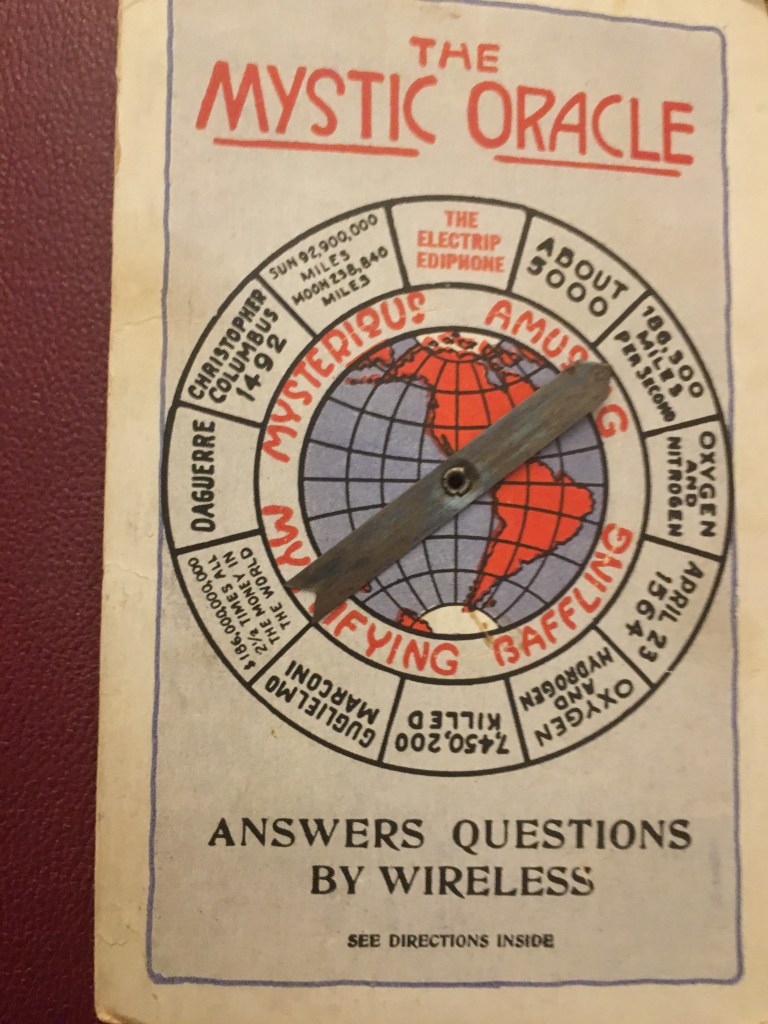
"Wireless -- I loved that misnomer. The corners of London sitting rooms would contain a vast array of cables, leads, and paraphernalia, and the popular music-hall joke of the times was 'What's all that wire for?' 'Wireless, you fool !'"
Hermione Gingold. How to Grow Old Disgracefully: an autobiogrphy (New York: St. Martin's Press, 1988) **
DULCIFY
"This verb comes from the Latin words “dulcinficare” (“to sweeten”) and “dulcis” (“sweet”). The same root is used to indicate sweetness of all kinds — from dulcet tones to dulce de leche. To “dulcify” something implies sweetening its taste, but used in context with a person, the word describes soothing or calming them down. You can dulcify an upset friend, but you can also dulcify the coffee you drink while chatting with them."
https://worddaily.com/words/Dulcify/
**
From the first issue of WORD WAYS
The first issue, published in 1968, leans heavily on material published from The Enigma, the magazine of the National Publisher’s League, in the mid-1920s!
Of its then-current contributors, the most mysterious was Edward L. Lee, who kicked things off with the amusing challenge to “improve” a simple American proverb, Ph.D-style. This meant rewriting it into scholarly impenetrability. His example:
A rolling stone gathers no moss: While bryophytic plants are typically encountered on substrata of earthly or mineral matter in concreted state, discrete substrata elements occasionally display a roughly spherical configuration which, in the presence of suitable gravitational and other effects, lends itself to a combined translatory and rotational motion. One notices in such cases an absence of the otherwise typical accretion of bryophyta.
from T.Campbell , editor of WORD PLAY **
BIG CABINETRY
In China nobody is called an architect; we call it 'big cabinetry' or 'small cabinetry. 'Big cabinetry' you build houses ; small cabinetry, you make furniture -- same method. It';s an old type of language...it's puzzled together...."
AI Weiwei. " Honestly, I think it's a Useless Building" in "No Place Like Home" by Jay Cheshes,
Smithsonian Magazine (January-February 2024)
GRIFFONAGE
"This word is borrowed from French and is rightly defined as ' careless handwriting .'
"Sometimes, reading a doctor's prescription feels like cracking a secret code. But here's the intriguing part: If you show a doctor a prescription written by a colleague, they will probably decipher it perfectly. Perhaps there's a mysterious class on griffonage at medical school." \ https://www.dictionaryscoop.com/article/10-Common-Things-You-Didnt-Know-Had-Names?utm_source=blog&utm_campaign=blog-20231229
** OUTDUMB
"Had I fooled (TED) Williams -- 'outdumbed him' - as it is called -- by throwing the easy pitch?"
Whitey Ford, as reported by Irv Goodman in The Saturday Review (March 3, 1962)
&& NEW WORDS IN TOWN:
HOSTBUSTER (n) -- rude guest
DIETGETIC (adj)--
in a movie or a play when a character loses weight as the action progresses, as in Hamlet or Jumbo.
EEKPHRASES --noun (pl): descriptions of or commentaries on a sentence poorly written or poorly spoken.
** ] The original words in this sentence have been cloned and have been replaced by their exact duplicates.
** When I sell liquor, it's called bootlegging; when my patrons serve it on silver trays on Lake Shore Drive, it's called hospitality."
Al Capone
**
Pass the Buck
Pushing responsibility onto someone or something else, is “passing the buck.” The blame for this idiom lies in the game of poker. During the frontier days, a knife with a buckhorn handle was often used to indicate the dealer. If the player didn’t want to deal, he could skip by “passing the buck" to the next player. The gambling phrase was adopted widely throughout World War II to refer to the way some countries avoided confronting threats. The idiom became so popular President Harry Truman had a sign made for his desk that famously read, “The buck stops here.”
"In Lao the word that sounds like "see" in English means "fuck." It took me a while to understand why "See you" always got a laugh. "
(Lao is a tonal language, with 6 tones, so that a word like "see" will change meaning depending on the tone (the rise and fall of the voice). That made for all kinds of embarrassing (or hilarious, if you were Lao) mistakes that foreigners learning the language would make. )
** Any husband who has ever had an argument with a woman can tell you -- English too is a tonal language. **
ON THE FALSE FRIEND "MIST"
A cosmetics company launched a deodorant spray in the 70's or early 80's, called Blue Mist. After a successful launch in English speaking markets they went into others, including Germany. They simply translated the name to Blauer Mist without checking the meaning. 'Mist' in German means dung. Must put some of that spray on before a big date!
Mike Clark **
ON TRYING TO GET THE ARTIST CLYFFORD STILL TO STOP TALKING
I sd “Be still, Still! Still, Still went on talking. He was still Still But Still was also not still If you know what I mean.
Glad you could use my Lao story, Lou. Nice quip re English as a tonal language. I realized that at an early age when my mother would say to me, “Don’t use that tone with me, mister!”
 PhillipsMiscellany
“English too is a tonal language.” I really like that.
LikeLike
Cool.
LikeLike
Would you call me at 8pm on Monday evening to set up Tuesday’s plan. J.
Some good bits of interest here.
LikeLike
OK –What is Tuesday’s plan?
LikeLike
No bryophytic plants growing on your forever-roving brain either.
LikeLike
Just mold!
LikeLike
Glad you could use my Lao story, Lou. Nice quip re English as a tonal language. I realized that at an early age when my mother would say to me, “Don’t use that tone with me, mister!”
LikeLike