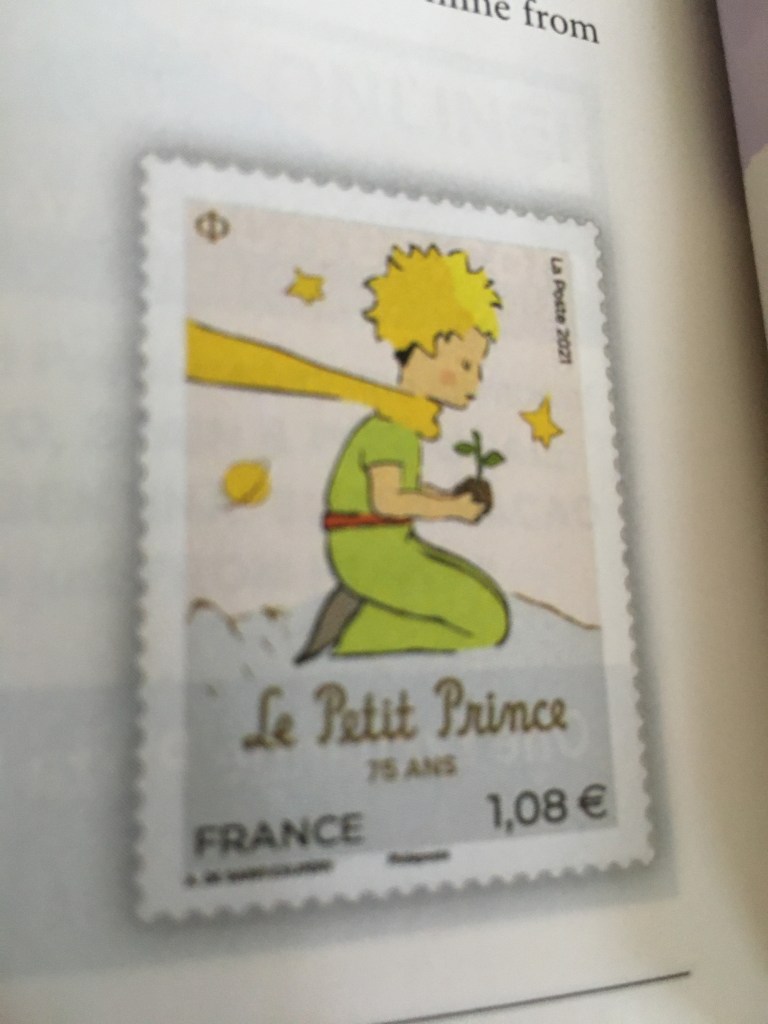
">“The 75th anniversary of the publication of Le
Petit Prince in France is commemorated  by a
single 1.08 e stamp available in a sheet of 15.
First available in the United States in 1943,
it was banned by Vichy France and not published
until after the liberation. The novella was
written by writer and aviator Antoine
de Saint-Exupery and is the story of a young
prince who visits various planets and learns
about ‘loneliness, friendship, friendship,
love, and loss.’ “

William Silvester. “New World Issues” in The
American Philatelist (September 2021)
**

ON THE BEST SELLING NOVEL --THE DOGS OF WAR --AND
 A SUCCESSFUL INVASION TO OVER THROW A REPUBLIC

‘There need only be five rules, Strike hard,
strike fast, and strike by night. Come unexpected
and come by sea. Parenthetically, the eventual
book was imitated twice. In 1975, the French
mercenary, Bob Denard attacked and took over
the Comoro Islands, at the top of the Mozambique
Channel.
   “He was acting with the knowledge, assistance,
and on behalf of the French government. Amusingly,
as the French mercenaries came up the beach in the
predawn darkness, they all carried a paperback edition
of Les Chiens de Guerre (The Dogs of War) so that they
could constantly find out what they were supposed to
do next. Denard succeeded because he came by sea.”

Frederick Forsyth. The Outsider: My Life in Intrigue.
(New York: G.P. Putnam’s Sons, 2015)

**
ON THE DISCOVERY OF POETRY BY A WORLD WAR II SOLDIER

“I discovered poetry as a soldier during World
War II.In 1943, my unit, having finished Basic
Training in Miami Beach, was boarding a troop
train for a slow journey of several days across
the country to an unknown destination, when a
Red Cross worker handed us a bag of necessities
for the trip, a toothbrush, comb, candy bar –
and a paperback. My book was, fatefully, a
Louis Untermeyer anthology of a great poems
of the English Language, which I devoured on
the train. Three days later when I got off
that train I knew what I wanted to be –a poet
 – in spite of, at the age of eighteen,
never having written a line.”

Edward Field. The Man Who Would Marry Susan Sontag.
 (Madison, Wisconsin: The University of Wisconsin,
2005)
**
ON UPLIFTING POEMS & BOOKS FOR CHILDREN
IN THE VICTORIAN ERA

“The rot set in with Lewis Carroll’s Alice, who,
‘though slightly too passive to qualify as one
of the new breed of naughty children, has great
trouble trying to remember the improving poems
she has been made to learn and instead recites
inspired nonsensical parodies’ (Peter Keating),
and with such authors of books for children a
s S.R.Crockett, whose The Surprising Adventures
of Sir Toady Lion (1897) bore the provocative
subtitle, ‘An Improving History for Old Boys,
Good Boys, Bad Boys, Big Boys, Little Boys,
Little Boys, Cow-Boys, and Tom-Boys’.1897
also saw the publication of What Maisie Knew.
Henry James didn’t go for subtitles.”

D. J. Enright. Interplay: A Kind of Commonplace Book
(Oxford: Oxford University Press, 1991)


**
ON THE SMELL OF GREAT BOOKS

“I love the fact that I went to the library and
read every book there. So I loved touching the
books, smelling the books. The great books are
best not only when they read well, but they smell
nice. A new book smells fine, but an old book
smells even better. Books are that important to me.”

Ray Bradbury.  Ray Bradbury: The Last Interview and
Other Conversations, edited by Sam Weller (Brooklyn:
Melville House, 2014)

**

ON THE  SMELL OF NEW BOOKS

“…my sweetest memory of college is on the nuzzling,
sedate side. At the beginning of each semester, I
would stand before the books required for my courses,
prolonging the moment, like a kid looking through
the store window at a bicycle he knows his parents
will buy for him. I would soon possess these things,
but the act of buying them could be put off. Why
rush it? The required books for each course were
laid out in shelves in the college bookstore. I
would stare at them a long time, lifting them,
turning through the pages, pretending I didn’t
really need this one or that, laying it down
and then picking it up again. If no one was
looking, I would even smell a few of them and
feel the pages….”

David Denby. Great Books (New York: Simon
and Schuster, 1996)
**


ERNEST HEMINGWAY MENTIONS JUST ABOUT THE BEST BOOK
EVER WRITTEN ON THE CLAP


“ Now take The Big Sky by [A.B. Guthrie] . That was
a very good book in many ways, and it was very good
on one of the diseases…just about the best book ever
written on the clap.” Hemingway smiled.

Robert Manning. “Hemingway in Cuba” in
The Atlantic Monthly (December 1954)

**

WHAT I HAVE LEARNED FROM
STUDENTS IN MY ENGLISH CLASS

The Wife of Bath
Is an important character
In The Grapes of Wrath.
**


WHAT I HAVE LEARNED FROM
STUDENTS IN MY ENGLISH CLASS (2)

None of my students think it odd
That Captain Queeg
Is with Queequeg
On the U.S. Peguod.

LJP
 PhillipsMiscellany
Favorite student answers on test: T S Eliot knew Dante personally.
Boswell was born twenty years after Johnson (wrong), and throughout their lives together that age differentiation remained constant. Prof. Comment: he never caught up?
LikeLike
Thank you for taking the time to respond, Birthdayboy.
LikeLike
Writing about loving books rather than what’s in them seems an indication of some kind of personality disorder. Akin to collecting cats or saving old license plates or pizza boxes. People to be shunned so as not to give them a chance to tell you about their enthusiasm for their weird hobbies.
LikeLike
Thanks, Lou–alway fun to read about writers and books. Hard to believe that Bradbury read every book in a library. But he may have. He once said that he never suffered from writer’s block. In fact, the condition puzzled him. “If you had it, why would you want to write?” he wondered. He was one of the most prolific writers of all time. So he may have been one of the most prolific readers of all time too.
LikeLiked by 1 person
Thank you for taking the time to respond. Always great to hear from you!
Love,
Louis
LikeLike
Do I smell a new school — the olfactory school — of literary criticism?
LikeLike
THE OLFACTORY MANUFACTURES A LOT OF OI
LikeLike