BITS & PIECES OF A MISPLACED LIFE: THE JOYS OF READING


AS A GUEST AT FRANCO’S PALACE FOR A PICNIC FILM STAR

ESTHER WILLIAMS LEAVES THE PARTY TO READ A NOVEL BY ERNEST HEMINGWAY (1961)

    ".. I withdrew from the group , stretched out 
on a blanket and pulled a book out of my purse that 
I'd been wanting to read. It was Ernest Hemingway's 
For Whom the Bell Tolls..
     Fernando (LAMAS) was all over me like a shot, with something resembling a flying tackle. He snatched the 
book out of my hand and hid it under the blanket.
     "Are you crazy?" he asked with a wild look in 
his eyes.
     "What the hell's the matter with you?" I was 
clueless.
     "Esther, don't you know that this is the most 
banned book in Spain?"
     "Banned? By whom?"I still didn't get it.
     "By who do you think? By your host this afternoon!"
...
     So what I'd done was no mere faux pas. It was 
roughly the equivalent to pulling out a copy of the 
Talamud at a Hitler Youth rally. If anybody else besides Fernando had seen me, we'd have been instant pariahs, 
and all the movie star celebrity in the world wouldn't have saved us.

Esther Williams. The Million Dollar Mermaid: 
an autobiography with Digby Diehl (New York: 
Simon & Schuster, 1999)
ON THE ROAD AND WOMEN READERS

"On the Road electrified young women as well as men. The
poet Janine Pommy Vega, then fifteen, who found in 
Kerouac's novel " the intensity that was missing in my
life," set out for New York, where she met Ginsberg, 
Huncke, and Peter Orlosky. The words of On the Road
shot through Marilyn Coffey, later a feminist activist
"like a fusillade of bullets." After buying some candles
and wine, she began to write, feeling "free to say
anything I wanted...the equal of any man." The Teenage
Janis Joplin, starving for companionship in Port Arthur,
Texas, first read about Kerouac in Time magazine. "I
said 'Wow! and spit." If feminism means the insistence 
on a woman's right to full, independent, and original
life, On the Road served in these instances as its
catalyst."

Ann Douglas. "Strange Lives, Chosen Lives: The Beat
Art of Joyce Johnson" introduction to Minor Characters
by Joyce Johnson (New York: Anchor Books, 1994)
A BOOK REVIEW -- LADY CHATTERLY'S LOVER

Although written many years ago, Lady Chatterley’s 
Lover has just been re-issued by Grove Press, and 
this fictional account of the day-by-day life of an 
English gamekeeper is still of considerable interest 
to outdoor-minded readers, as it contains many passages
on pheasant raising, the apprehending of poachers, ways 
to control vermin, and other chores and duties of the
Professional gamekeeper.
   Unfortunately, one is obliged to wade through many 
passages of extraneous material in order to discover 
and savor those highlights on the management of a 
Midland’s shooting estate and, in this reviewer’s 
opinion, this book cannot take the place of J.R. 
Miller’s Practical Gamekeeping.

  
               Ed Zern in Field & Stream
*******

"I hated Madame Bovary when I was sixteen, and its
heroine too. I thought they were too emotional,
novel and protagonist alike, too overt with their
passions. But I love it now --the book, if not it
heroine. I enjoy analyzing her melodrama, even if
I haven't forgiven her for indulging it. I also
want it for myself.I always have those high and
lows of feeling,everything turned superlative.
I've lifted emotional blueprints from Emma just
like she lifted them from books of her own.

Leslie Jamison. The Empathy Exams (NY:Graywolf
Press, 2014)
PETER PAN AS A GREAT CHARACTER

"Peter Pan is great character. He's forgetful,
selfish, cruel. he's an eleven year old, right
at the cusp of his sexuality. He has this great
quote: "Oh, the wonderfulness of me." You hear
that from an adult, you go 'Eat my shorts.'"

Robin Williams. Playboy interview (January 1992)
**
ON BEWILDERMENT by Richard Powers

"It's a book about ecological salvation that
somehow makes you want to flick an otter on
the back of the head, for no good reason at
all."
Dwight Garner. The New York Times (Sept.16,2021


**
EDNA FERBER , DETECTIVE

Fictional detectives come in numerous shapes &
sizes, but is there a term to describe real life
persons who are used by ingenious authors to
solve crimes in novels. Edna Ferber, for example,
was a best-selling novelist  (So Big, Giant) and a
Broadway playwright ( Dinner at Eight and Stage
Door). She, however, has been resurrected as a
detective in a series of eleven mystery novels 
written by
Ed Ifkovic.  A few of the titles are Lone Star (2009),
Escape Artist (2011) and Indian Summer (2020).
     I learned all of this by reading  Jon L. Breen’s 
article “Edna Ferber, Detective” in Mystery Scene magazine
(number 170, Winter 2021) in which Breen gives background 
and brief synopses of Ifkovics’ novels.
   Escape Artist, for example, takes place in 1904 when
Ferber is a 19 year old reporter in Appleton, Wisconsin,
where she and Appleton-born Harry Houdini work together 
to solve the murder of a high-school girl.
Jon L. Breen writes “Edna’s father, learning of her 
interview with Houdini, remarks. “All Jews are escape
Artists.” The meaning of this would be obvious to 
anyone who lived through the 20th century, if not 
to the young Edna of 1904.”

**


CHARLES T. YERKES & THEODORE DREISER

“Yerkes is remembered today for the observatory
Bearing his name, which he donated to the University 
of Chicago, and even more signally, perhaps, for 
serving as the model for the character of Frank 
Cowperwood, the hero of Theodore Dreiser’s novels 
The Titan and The Financier. In his own time Yerkes 
was better known as a man-eating shark of the 
transportation industry, whose formula for success, 
as he bluntly stated it, was to buy old junk, fix 
it up a little and unload it upon other fellows.”

John Burke. Rogue’s Progress: The Fabulous Adventures 
of Wilson Mizner (New York: G.P. Putnam’s Sons,1975)

**


BITS & PIECES OF A MISPLACED LIFE: HUMOR & COMEDY

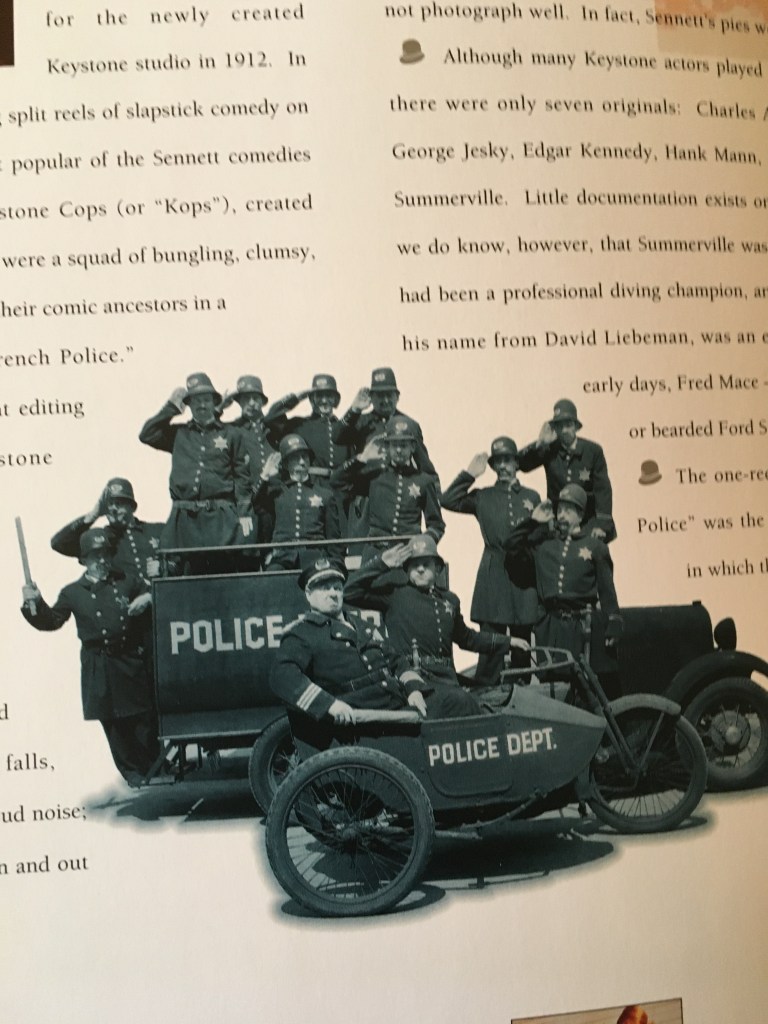
MACK SENNET’S KEYSTONE KOPS

A male gynecologist is like an auto mechanic who has never 
owned a car. 
              Carrie Snow

THE TRICK IN PLAYING COMEDY
“The trick in playing comedy is to make an audience believe what is going on and for this you have to believe it first yourself. This is why I think a comedian is basically an actor. The art of comedy is like the art of acting – except that in comedy, the actor has to believe the most preposterous and exaggerated things.”

Jack Benny

Sunday Nights at Seven: The Jack Benny Story by
Jack Benny and his daughter Joan (New York: Warner
Books,1990
**
THE COMEDIAN'S JOB

Since the days of Pigmeat Markham, not to mention Lenny Bruce, the comedian's job has been to say the unsayable -- to give voice to the things that stink or bite us in the heart.

Hilton Als. "Bros' Night Out," in The New Yorker (February 10, 2020)
**


ABORTION

President Bush was against abortion, but for capital punishment.  Spoken like a true fisherman: Throw them back, kill them when they’re bigger.

     Elayne Boosler


**
“As to humor, I can only tell you what Schwanzleben said in his
Work, Humor After Death. He hits on this point indirectly when
He writes, “All laughter is as muscular rigidity spasmodically relieved by involuntary twitching.”

Robert Benchley

**

WOODY ALLEN’S NIGHTMARES

“….I’m not an active sleeper. However I have experienced dreams on rare occasions. In one I am attacked by a cheese. In another my body is dipped in a vat of feathers. In yet another, I make love to some moss formations. A fairly common one has me straying through an empty field, kissing rare minerals while my mother, symbolized by a penguin, smokes a Kool and wrestles the Harlem Globetrotters. During the filming of Casino Royale, I dreamed I was Ursula Andress’ body stocking.,

Playboy Interview with Woody Allen (May 1967)


**
MARILYN MONROE DISCUSSES HER FAMOUS NUDE PHOTO FOR THE
COVER OF PLAYBOY

Marilyn Monroe “told us the studio had instructed her to deny that the photograph was her body, to which she had asked, “Okay to claim the face as mine?”
   “Just deny everything,” was their final direction.
  “Later the first reporter to inquire asked,” Why did you pose in the
Nude?”
    “Her answer: ‘That’s the kind of picture they wanted.’
    “Next reporter: ‘Is it true that you had nothing on?’
    “ ‘Not true,’ she said. “I had the radio on.’
    “Reporter: ‘Oh, you know what I mean.’
    “’If you mean was I wearing anything, well, I was, said M.M.’
    “’What?’ he asked.
   “’Chanel Number Five,’” she said.”

Joseph Cotton. An Autobiography: Vanity Will Get You Somewhere
(San Francisco: Mercury House, 1987)
    
In his biography of Wilson Mizner –Rogue’s Progress –
John Burke writes “The wisecrack is supposed to be a uniquely American contribution to humor.” He goes on to quote
some of Mizner’s witty remarks (whether or not such quotations are wisecracks, I leave it to the reader to judge):

“Be nice to people on the way up because you’ll meet them on the way down…. Treat a lady like a whore and a whore like a lady…. He’d steal a hot stove and come back for the smoke…. If you copy from one author, it’s plagiarism. If you copy from two, it’s research….The first hundred year are the hardest….Most open minds should be closed for repairs….The life of a party almost always winds up in a corner with an overcoat over him….I never saw a mob rush across town to do a good deed….”

John Burke. Rogue’s Progress: The Fabulous Adventures of Wilson Mizner (New York: G.P. Putnam’s Sons,1975)


**

BERT LAHR

Bert Lahr—
His career went very far
(You may skip this 3rd line)
After he played The Cowardly Lion).

LJP

I try not to play characters that ever have ever have any self-awareness that their conviction is boneheaded. And I think that can either be funny or dramatic. After all, a character doesn’t know whether they’re in a comedy or a drama.

 Steve Carell, in an interview with Ana Marie Cox  New York Times Magazine (December 6, 2015)

BITS & PIECES OF A MISPLACED LIFE:WORDS,WORDS, WORDS #4

FRANKIE LAKE, MEMBER OF BIG BOY’S GANG, AND PAT O’BRIEN IN CHICAGO AND THE LADY FROM BRISTOL

“We were pals. He sat down , opened his coat. In full view
(Glimpsed in a mirror) was a grim .45 in a shoulder holster. To put it mildly, I was somewhat concerned.   "Hey, Frankie boy — what the hell?”
   Frankie smiled . “Don’t panic, pal —I’ll park the Lady from Bristol — pistol in Cockney slang —“behind your mirror.”
   “B-b-b-b-b but why, Frankie?
   He cut me off. “Hell, pal, I can’t tote a rod in the theater  — they’d think I’m a gangster! I’m leaving the Roscoe here — justnput it back of the mirror like a nice boy.”


Pat O’Brien: The Wind at My Back: the Life and Times of
Pat O’Brien (Garden City,New York: Doubleday & company,1964).
**
ACRONYMS FOR ALL OCCASIONS 

FUBAR — Fucked up beyond all recognition
SNAFU — Situation normal, all fucked up
JACFU—   Joint American-Chinese fuck up
JANFU —- Joint Army-Navy fuck up
SNSFU. —  Situation  normal, still fucked up
TARFU —    Things are really fucked up
See Newsweek (February  7, 1944). In that article the F word
was changed to Foul up or fouled up)

**

THEATRICAL SLANG — THE GODS

“During the Twenties —and indeed long before and for a time afterwards — throughout Great Britain the galleries of theaters, the cheapest sections that hugged the roofs, were known to many as ‘the Gods’.
   Because of the low cost of seats at this time, the majority of gallerygoers were young, with girls, usually, outnumbering the boys.’

Hence, from 1922-1930 in London Tallulah Bankhead was
Known as “The Darling of the Gods”.

Kieran Tunney. Tallulah Darling of the Gods. (New York: 
E.P. Dutton & Co.  1973)

**
ON THE WORD AUTOPSY

“The word autopsy goes back to the Greek  word autopsia
which means literally to see for yourself. In other words you’re going to open up that body and look for yourself to see what happened to this person. But it could apply to apply to anything.”Patricia Cornwall

Quoted by John B. Valerie. “Patricia Cornwall” in
Mystery Scene magazine, no. 170 (Winter 2021)
**

ENGLISH

What Eden offers better sentences,
Sometimes larger than hedgehogs,
Burrowing adjectives to tease
With whoop, hail, brief pause,
Verb rabble, then trouble,
Adverbel jigs,
PIping unto the catalogue of saints?
What can be more pure
Than doric orders of pronouns,
Some handsomely spotted
& farsighted as any grammar
Besieged by exclamations! Alas!
Inspiring a wicked broth
Of exchanges 
Endured by linguists
& their next of kin,
Nouns: Rakehells on holidays,
Not pious, not always Proper,
Some phrases clipped
To the nose,
But loose as Bojangles.
A lingo whose prepositions
Stampede even unto
The Anatomy of Criticism.

Louis Phillips


BITS & PIECES OF A MISPLACED LIFE: PROFESSIONS #3

AIRLINE WORKERS

"Remember they are dealing with angry, disgruntled,
miserable people. And then they leave home for work.
Not only is your safety and well-being in their hands,
but more important, so is your expensive designer 
luggage."
            Joan Rivers
**

Melissa Rivers. The Book of Joan (NY: Crown Archetype,
2015)

EPIDEMIOLOGIST

“Of all the arts, singing is perhaps the most ominous to an epidemiologist. In that imaginary diagram of aerosolization, a comic would be expelling dribble, but a fine full-out singer would be a toxic fountain, misting the virus deep into the tenth row. (One of the first documented superspreading events in this country involved a choir rehearsal.) Singers wondered for a desolate year if they would return to work.”

Adam Gopnik. “Sitting With Strangers” In The New Yorker (June 14, 2021)

DRAMATIC CRITIC

"If I wished to complain, which I don't, I might say
that a dramatic critic, or even a composite of several
dramatic critics, is hardly a suitable romantic lead
for any play, and also that the trade secrets of this
glum profession are apt to seem either dull or
incomprehensible to the average audience."

Wolcott Gibbs, reviewing Arsenic and Old Lace
for The New Yorker (January 18, 1941)

**

PROFESSIONAL GAMBLER

“I could outsmart, outcheat, out-connive, and roll higher than ’em all in my day,” he said. “And that’s no lie.” “The son of a wandering gambler he never met, Titanic Thompson took gamblers’ money any way they wanted it taken. One story is he threw a lemon onto a high roof to win $500 from Al Capone. Another insisted he sat at a dice table with Howard Hughes and walked away $10,000 ahead. Testimony under oath had him playing poker all night with the thief who fixed the World Series, and when the thief was shot dead, the prosecuting attorney, who smelled a rat, asked Thompson what he did for a living. There in the witness-box with diamonds on his finger, handsome as daybreak and resplendent in a fine suit with a silk tie, the hustler who had put his hand on a Bible and promised to tell nothing but the truth, testified: “I play a little golf for money.” Thompson married five women and killed five men, not because he heard money talking, but because he could do it and because, he said, sunshine in his smile: “They needed it.”

DAVE KINDRED. “Myths of The Titanic” in GOLF DIGEST (June 19, 2020)

+**

**

PRISON WARDEN

“ ’Tread softly and carry a big stick.’ was my
first lesson in penology, on my arrival at Clinton
Prison on March 1st, 1905, it was followed literally.
When I reported for duty that night, I was handed
a pair of sneakers and a club. The sneakers, to enable 
the guard to make his rounds noiselessly, so as not 
to disturb the sleeping forms within the dark cells, 
and the club to be used in emergencies should any of
 those forms become unduly active. I had rather a 
hard time of it on that first tour of duty.”

Lewis E. Lawes. Twenty Thousand Years in Sing Sing.
(1932)/ (the book was made into a 1932 movie
starring Spencer Tracy)

**
GRAVEDIGGER

  “Graves are customarily made with their length running east and west, so that the corpse lies with his feet to the east and his head to the west. It used to be supposed that the summons to the Last Judgement would come from the east, and that it would be better for the dead man if he could rise on the resurrection morning with his face towards the dawn. An old Welsh name for the east wind is ‘the wind of the dead men’s\feet.’ To dig a grave north and south was extremely unlucky, and indicated either a lack of respect or definite malice towards the man who would lie in it…”

Christina Hole. Encyclopedia of Superstition (1961)


SAILOR

Question: Where did the term gob referring to sailors come from?

Answer: There are two theories on this one. This term first showed up in regard to sailors around 1909 and may have come from the word gobble. Reportedly, some people thought that sailors gobbled their food. The term also may come from the word gob, which means to spit, something sailors also reportedly do often. English coastguardsmen were referred to as gobbies because of their spitting habits.

**
GRAVEDIGGER

  “Graves are customarily made with their length running east and west, so that the corpse lies with his feet to the east and his head to the west. It used to be
 supposed that the summons to the Last Judgement would come from the east, and that it would be better for the dead man if he could rise on the resurrection morning with his face towards the dawn. An old Welsh name for the east wind is ‘the wind of the dead men’s
 feet.’ To dig a grave north and south was extremely unlucky, and indicated either a lack of respect or definite malice towards the man who would lie in it…”

Christina Hole. Encyclopedia of Superstition (1961)

*
WHY I AM NOT A WORLD FAMOUS POET

When it comes to writing poetry,
I am out of my element:
Helium.


Louis Phillips
**

BITS & PIECES OF A MISPLACED LIFE: TELEVISION

 TELEVISION IN ENGLAND AND AMERICA

One thing I must set down about England
is that television was in general use
over there before we had it, and I was
surprised to see the sets in the store
windows. The Ringling Circus radio publicity
department had used the clown Felix Adler on
a television program in New York City as far
back as 1932, but this was a novelty "one-
shot" because television wasn't for public
consumption in the States back then.
  "I did several radio shows in England and
one television appearance as long ago as 1937.

Emmett Kelly. Clown (New York: Prentice-Hall,
1954)

TELEVISION IN 1946

Yul (BRYNNER) had bee dabbling in television since 1946, when only

a couple of thousand television sets were privately owned and shows

were broadcast only two hours per day twice a week.

Maura Spiegel. Sydney Lumet: a Life (New York: Saint Martin’s Press, 2019)

**
ON TELEVISION & NEWSPAPERS

“…tube and newspapers give us without let-up the multitudinous currencies

of our greedy capitalism (hah!), a system thst would immerse each of us in

boiing detergents if there were profit in so doing.”

Reed Whittemore. The Poet as Journalist (Washington, D.C.: The New Republic Books, 1976)

SGT BILKO, STARRING PHIL SILVERS

“The 1955-59 original series broke barriers by boasting television’s

first racially and sexually integrated cast, an achievement usually claimed

by Star Trek.”

** “The original show’s supporting cast were individually perfect (The Manchurian Candidate pays tribute by naming its soldiers after the actors who played Bilko’s Platoon).

Kim Newman on SGT BILKO in Syntax Society Magazine (May 1996).

THE FIRST IMAGE SCANNING DEVICE

“From 1884 until the 1920s the only device for breaking an image down and converting it into electrical impulses was a mechanical scanning device known as the ‘Nipkov Dish’ named after its inventor Paul Nipkov… The bulk and complexity of the device, as well as the poor quality of the pictures led to supplant the mechanical device with a more efficient all electronic scanning device. Jeff Greenfield.Television: The First Fifty Years (New York: Harry N. Abrams, 1977) **

MYSTERIES ON SUNDAY NIGHT TELEVISION 1974-75. A SMALL STEP FOR WOMEN AS CHIEF OF DETECTIVES

Tim Brooks and Earle Marsh, authors of The Complete Directory to Prime Time TV Shows 1946-Present (1992) tells readers that “Amy Prentiss was one of four rotating elements that made up the 1974-1975 edition of NBC Sunday Mystery Movie. The others were Columbo, McCloud, and McMillan and Wife.” Jessica Walter played the less-remembered Amy Prentiss (Who was the first Chief of Detectives on a big city police force. “Unfortunately, viewers took less readily to the idea of woman as boss, and the program was canceled after a short run.” ps- Can you name the actors who played Columbo, McCloud, and McMillan? ** Answers: Peter Falk, Dennis Weaver, & Rock Hudson

Add title


This image has an empty alt attribute; its file name is television.jpeg


TELEVISION IN 1946

Yul (BRYNNER) had bee dabbling in television since 1946, when only

a couple of thousand television sets were privately owned and shows

were broadcast only two hours per day twice a week.

TELEVISION IN 1947

Kukla, Fran and Ollie is an early American television 
show using puppets. It was created for children, but soon watched by more adults than children. It did not have 
a script and was entirely ad-libbed. It was broadcast 
from Chicago between 1947 to 1957. Comedienne Fran Allison starred, interacting with puppets, Kukla and Ollie (and sometimes other puppets) whose puppeteer was the show's
 creator, Burr Tillstrom. After the original run, the team appeared in other productions over several decades.

Maura Spiegel. Sydney Lumet: a Life (New York: Saint Martin’s Press, 2019)

REED WHITTEMORE AS TELEVISION CRITIC

A television set sits at my left hand a window
at my right -- which shall I look at and out?
The TV,obviously, I am paid munificently by this
noble rag* to watch the tube and its vision of
life, not the yellowing leaves and the blue sky.
Nature's programs change slowly, except for
occasional storms they offer no challenge to
the journalistic mind. And nature's art is
excessively subtle; it knows not the world
bludgeons. No, the journalist must stick with
his tube -- and of course his newspapers."

* The New Republic

Reed Whittemore. The Poet as Journalist
(Washington, D.C.: The New Republic Books,
1976)
GEORGE TOZZI

George Tozzi
Never met Ozzie
& Harriet,
Or if there is a tape of their meeting,
   he decided to bury it.

Louis Phillips

BITS & PIECES OF A MISPLACED LIFE: WORDS, WORDS, WORDS, #4

from Rickty Jay’s collection
BACKSTAGE AT THE EARLE

…vaudeville was very proper. Backstage at the
Earle, the management had posted a sign: 

THE THEATER CATERS TO LADIES, GENTLEMEN
AND CHILDREN, VULGARITY WILL NOT BE 
TOLERATED. DO NOT USE THE WORDS HELL, 
DAMN,DEVIL, COCKROACH, SHIT, ETC.

Phil Silvers. This Laugh Is On Me, with Robert 
Saffron (Englewood, N.J. Prentice Hall, 1973.

**

Short story writer O’HENRY (William Porter) &
HIS LOVE FOR WORDS 

"And Porter liked arcane words – “vespertine,”
“mucilaginous,” “caoutchouc,” – and malapropisms:
 **
  “He wants his name, maybe, to go thundering
down the coroners of time.”
 

Louis Menand. “The Big Reveal” in The New Yorker
(July 5, 2021)
**

 
ON THE ORIGIN OF THE WORD VELCRO


“ Velcro: In 1948, the Swiss engineer George de Mestral 
took a nature hike and returned with his trousers (including, presumably, his fly) covered with burrs. After examining 
these prickly hitchhikers under a microscope, he noticed 
they had tiny hooks that clung tenaciously to the small 
loops of thread in his pants. Burr-eka! Inspired, he devised 
two strips of cotton fabric that stuck together because 
one had tiny hooks and one had tiny loops. He named his invention "Velcro," a combination of the French "velours" (velvet) and "croche" (hook). Soon the generic name "velcro" jumped into common parlance, where it ... well, stuck.”

Rob Kyff, a teacher and writer in West Hartford,
Connecticut

**
 “
THE PLAUSIBLE IMPOSSIBLE

“The plausible impossible” is a term of art
unique to cartooning. It is what holds  Bugs
Bunny up when he runs off a cliff , traverses
A yawning chasm, and continues running on
the other side, completely ignorant of the
terrible fate that, except for a magical, momentary
suspension of the laws of gravity, should
have been his. It is the guiding comic principle –
at once thrilling and ridiculous – that lies at the 
heart of cartooning."


Mary –Lou Weisman. “Prologue” to Al Jaffe’s Mad
 Life (New York: HarperColliins, 2010)

ON FRIDGING

"In comics, the violent death of a woman as a
plot device in a story focused on a man was
 so common that women coined a term for it,
fridging. After the 1999 website Women in
 Refrigerators, documenting the plethora of
gruesome endings for female characters." 


Rebecca Solnit. Recollections of My Nonexistence
(New York: Viking, 2020)
**

WHO COINED THE PHRASE :”INNOCENT BYSTANDER"?

…Irving Cobb, rewrite desk, New York World, 
watched  a man who was shot while simply
walking along the street.Back in the city room , 
Cobb, nerves rattling, made the typewriter carriage 
jump up and down as he tried to figure out how
to describe it. Suddenly the phrase ‘innocent
bystander” jumped onto a page for the first 
time.

Jimmy Breslin. A Life of Damon Runyon (NY: 
Ticknor & Fields, 1991)
**

LIFE FORCE IN LANGUAGE


"I’ve gotten fond of the Chinese word “qi,” 
pronounced “chee,” meaning “life force,” (
plural: cheese), which my wife 
has used numerous times to whip me at Scrabble. '

Garrison Keillor

**
PAUL CELAN & THE WORD HEIMAT

“Celan lived in Bucharest for two years after the
war ended. Then in Vienna, moving in 1948 to
Paris, which remained his home – or would have
Done if he had believed in such a thing – until he
Died. ‘Heimat,’ he told Daive, ‘is an untranslatable word.
And does the concept even exist? It’s a human 
fabrication,: an illusion.”


Michael Wood. “This Happens Every Day” in The
 London Review of Books (29 July 2021)


**
A MISUNDERSTANDING


“In Manhattan, when actress Eve Arden 
announced that she would model a dress 
exposing her Popliteal Fossa, photographers 
came running, found themselves taking 
pictures of the back of her knees.”


Time. “Miscellany” (April 1, 1946)


**
THE MOST BEAUTIFUL WORDS IN THE ENGLISH LANGUAGE


"The author Henry James once said that summer afternoon 
was the most beautiful phrase in the English language.
 Ray Bradbury liked the word cinnamon. Tessa Hadley 
has expressed admiration for cochineal."


From DICTIONARY.COM


BITS & PIECES OF A MISPLACED LIFE: THE JOYS OF READING

THE FIRST POCKET BOOKS (Circa mid-1500s)

“Tradition has it that the first pocket books  were printed in Venice by the great Ahus Manutius who,
taking advantage of Eastern scholars for Crete and
Constantinople, published an incomparable series of
Handy classics, knowledgeably edited and impeccably
Produced. So popular did these volumes become, that
The 1536 Price List of the Whores of Venice advertised
Advertised the virtues of a certain Lucrezia Squarcia by
Noting that the lady was not only beautiful but also ‘enjoyed reading pocket editions of Petrarch, Virgil, and sometimes even Homer.”


Alberto Manguez in The Spectator 12 April 2003


**
WHEN CERVANTES CAME TO WRITE

"When Cervantes came to write the second part
--the sequel -- of "Don Quixote," he 
incorporated into his novel a real rival
writer Alonso Fernandez de Avellaneda, who
had already published a knockoff "Quixote"
sequel of his own. Tolstoy borrowed so much
from his own life, and so directly that he
once remarked that he lacked any imagination.
Kafka edited his harrowing "A Hunger Artist"
on his deathbed while suffering from starvation 
broughton by tuberculosis."

James Wood. "Where I'm Coming From" The New
Yorker (June 14,2021)

**
      READING ABOUT GLORIES OF WAR
As a boy I was an avid reader of G.A. Henry,
and stories about the glory of the Empire by
Rudyard Kipling. The nursery walls featured
reproductions of Lord Kitchener, The Charge 
of the Light Brigade, and The Thin Red Line
(the Guards Brigade) But now these things were
become an inescapable reality for me personally--
             
                  Theirs not to reason why
                  Theirs but to do and die.

What a shambles such nonsense made of all good
common sense. Most probably somewhere in Germany
there was a young man, with much the same ideas
as I had , and one of us quite possibly destined
to shoot and kill the other. The whole thing was
monstrous,utterly and unbelievably monstrous --
irrational, pitiable, ugly, and sordid." 

Baail Rathbone. In and Out of Character: an 
Autobiography (Garden City, NY: Doubleday,1962) 
**

JOHN WATERS ON READING

“It wasn't until I started reading and found books 
they wouldn't let us read in school that I discovered 
you could be insane and happy and have a good life 
without being like everybody else.”

—John Waters, American filmmaker, actor, writer, 
and artist

**
ON CENSORING BOOKS

After parent complaints about the use of racist epithets 
in To Kill a Mockingbird; Adventures of Huckleberry Finn; 
The Cay; Of Mice and Men; and Roll of Thunder, Hear My Cry, 
the Burbank (CA) Unified School District superintendent 
issued a statement removing the books from the district’s required reading lists for its English curriculum and 
banned the use of the N-word in all school classes. 
The books will be allowed in classroom libraries, but 
no student can be required to read them. At a board 
meeting, the superintendent stated, “This is not about censorship, this is about righting the wrongs of the past.”


THOMAS MORTON WRITES THE FIRST BOOK TO BE CENSORED IN AMERICA

Linda Cantoni at Hot off the Press writes that “the first two books of New English Canaan are mostly non-controversial, containing Morton’s observations on the native Americans, whom he respected greatly, and on the rich natural resources in New England. It was in the third book that Morton rolled up his sleeves and got down to his real purpose of skewering the New England Puritans, who, he said, ‘make a great shewe of Religion, but no humanity.'” As a result, writes Mental Floss’ Jake Rossen, “his book was perceived as an all-out attack on Puritan morality, and they didn’t take kindly to it. So they banned it,” making New English Canaan what Christie’s called “America’s first banned book” when they auctioned a copy off for $60,000. But you can read it for free at Project Gutenberg, bearing in mind the most American lesson of all from the life of Thomas Morton: when all else fails, publish a tell-all memoir."

from OPEN CULTURE

**
LIBRIANS IN MOVIES #1

"Is it any wonder that dad, a librarian
somewhere in Wales, goes Barmy in the book
stacks with the first pretty woman (Mai
Zetterlin) who evinces interest in one of
his favorite volumes (Concise History
of Codpiece)."

TIME (April6, 1962), unsigned review
(perhaps by T.E. Kalem) of Only Two Can Play,
starring Peter Sellers.

BITS & PIECES OF A MISPLACED LIFE: PROFESSIONS

OLYMPUS DIGITAL CAMERA

OLYMPUS DIGITAL CAMERA

MAGICIAN’S ASSISTANT

“ I met a woman once who was divorced from
 a professional magician. She hated this man 
with a passion. She used to appear with him in a
baffling trick where they exchanged places 
handcuffed and manacled in a locked cabinet.
I asked her how it was done. The divorcee and
her feelings  meant nothing compared to her
loyalty to the magical profession. She looked at 
me coldly and said, ‘The trick is told when the
 trick is sold.’”

Roger Ebert. Awake in the Dark (Chicago: The 
University of Chicago Press, 2017).
**
RAINMAKER

RUGGLES' CANNONS AT THE BATTLE OF SHILOH  

"About midnight April 6, 1862, a driving rainstorm pelted the soldiers after a massive bombardment by Ruggles' Battery. After the war, Daniel Ruggles became an inventor, submitting several rainmaking patents that included the application of explosives. Perhaps Ruggles associated  the downpour at Shiloh with the artillery fire he directed, and his experiences at Shiloh may have contributed to his  rainmaking ideas.  

Gregory A. Metz. Attack at Daylight and Whip Them: The Battle of Shiloh (April 6-7, 1862). (El Dorado Hills, California. Savas Beatie LLC, 2019).

**
GENTLEMAN’S GENTLEMEN: BASIL RATHBONE’S BUTLER

Film-star Basil Rathbone (well-known to mystery fans 
for his many films about Sherlock Holmes) was 
well-served for a time by an almost perfect butler 
named Poole.. Unfortunately, the gentleman’s gentleman 
had one slight flaw: non his nights off, he was a 
foot-pad who used a pistol to hold-up wealthy Londoners 
walking home at night. Poole was finally caught and was sentenced to two years and nine lashes with the 
cat o’ nine tails for carrying a pistol. 
   
In his autobiography –In and Out of Character—-Rathbone  
writes” I never found out the whys and wherefores of his predilection  for a Jekyll and Hyde existence. All I 
could get from him was that he had learned his technique 
from the movies:  they had taught him what not to do! 
And he claimed with complete sincerity, that he had 
never hurt anyone in his life, and had always contributed liberally to organized charity. 
“Anonymous , of course,” he had said with a wry smile.”
   As for the reference to Jekyll and Hyde, I wonder if  
Basil Rathbone was aware of the fact that Jekyll’s butler 
was also a gentleman’s gentleman named Poole.
**
SPIRITUALIST

"It's a good time to be dead -- at least, if you
want to keep in touch with the living. Almost a
third of Americans say they have communicated 
with someone who has died, and they collectively
spend more than two billion dollars a year for
psychic services on platforms old and new.
Facebook, Tik Tok, television: whatever the
medium, there's a medium."

Casey Cep. "KIndred Spirits" in The New Yorker
(May 31, 2021)


MUTTON SHUNTER

Mutton-shunter – A policeman who seeing prostituted
on a street  shunts –or moves them along.


Eric Partridge. A Dictionary of Slang and
Unconventional English.


CRIMINAL LAWYER


“The criminal lawyer, like the criminal, is the enemy of 
Law and Order. The criminal attacks society head on; the 
lawyer is trying to set you free after you have been
 caught 
so that you can go out and steal some more. Whether he 
succeeds or not, he profits from your crime. The only 
way you can pay him is out of the money you
ve got away 
with at one time or another, everybody knows that. It’s 
called  his share of the loot, of course.
It’s called 
‘the fee.’ But that’s only because he has a license that entitles him to do what he’s doing,, and
You haven’t.

"

Willie Sutton with Edward Linn.  Where the Money Was 

(New York: Viking Press, 1976)


**


QUIZ SHOW CHAMPION


“The Quiz Champion is not a self-thinker. He is too 
busy trying to recollect the words and thoughts of 
others,
which he has read and memorized. The Quiz 
Champion spits in the eye of thee music lover who 
wants nothing more than to spend a couple of hours 
listening to the Toscanini recording of Otello, but 
who is now burdened with a deep sense of guilt 
because he does not know (a) when the opera was 
first produced (b) who was the conductor, and (
C) the name of the soprano of the premiere.”


Harry Golden. Only in America (1959)

DRAMA CRITIC

“Probably the greatest privilege enjoyed by a commercial drama critics

is not having to go the theatre during the summer. It is a comfort and delight

on a par with the mint julip and not fastening the collar button of a shirt when one is

wearing a necktie.”

George Jean Nathan. The Theatre in the Fifties. 1953

.

**


**

***

BITS & PIECES OF A MISPLACED LIFE: MOVIES # 7

GRACIE ALLEN

“The well-known radio, TV, and  movie star one year ago was voted Hollywood’s most intelligent actress by
Southern California psychology students. She ran for
President of the United States n 1940 on the Surprise
Ticket. As a painter she exhibited her paintings at a
Manhattan gallery (one of her paintings is called –
Eyes Adrift as Sardines Wrench at Your Heartstrings.

”

Current Biography 1940


**
ON THE CASTING FOR BREAKFAST AT TIFFANY'S

It’s hard to imagine any other actress besides Hepburn bringing Holly Golightly to life on the silver screen. But her casting faced some strong opposition from the book’s author. Capote had envisioned Marilyn Monroe in the role. He later stated, "Paramount double-crossed me in every way and cast Audrey. She was just wrong for that part.

CARY GRANT ON FILM ACTING

"He talked about a simple thing like mixing
a drink in a scene. You had to mix the drink
correctly or someone in the audience would
be sure to notice and complain, but at the
same time you also had to make sure to hit
your marks and remember the dialogue. If you
dipped ice cubes in the glass 'you had to do
it gently,so the sounds of the ice hitting
the glass wouldn't make a distracting sound.
He made it sound like a six ball juggle."

Scott Exman. Cary Grant: A Brilliant 
Disguise {New York: Simon and Schuster,
2020)

**

CRUEL REVIEWER AT WORK

When the film Smash-Up, starring Susan Hayward and
Lee Bowman, was released in 1947, Life magazine  
said he played his part with all the enthusiasm of 
a stuffed moose.”


Beverly Linet. Susan Hayward: Portrait of a 
Survivor  (New York: Atheneum, 1980)

**

THE UNA MERKEL TRILOGY


UNA MERKEL

Merkel, Una –
Did you ever see her on a

Bucking  horse?

(The 3rd line came close to being extremely coarse!)

**


UNA MERKEL (2)

Una Merkel,
Decided not to audition for Dr.Jekyll
 
& Mr. Hyde.” She sighed. “I’m done

When they want me to play 2 roles for the price of one.”


*

UNA MERKEL (3)


Una Merkel –
Almost any cinema-loving jerk’ll
Tell you that Una was in DESTRY RIDES AGAIN.
In Greek terms, she was involved in the Agon.


Louis Phillips


BITS & PIECES OF A MISPLACED LIFE: THE JOY OF READING #3

“The 75th anniversary of the publication of Le
Petit Prince in France is commemorated  by a single 1.08 e stamp available in a sheet of 15. First available in the United States in 1943, it was banned by Vichy France and not published until after the liberation. The novella was written by writer and aviator Antoine de Saint-Exupery and is the story of a young prince who visits various planets and learns about ‘loneliness, friendship, friendship, love, and loss.’ “

William Silvester. “New World Issues” in The
American Philatelist (September 2021)


**

ON THE BEST SELLING NOVEL --THE DOGS OF WAR --AND  A SUCCESSFUL INVASION TO OVER THROW A REPUBLIC

‘There need only be five rules, Strike hard, strike
fast, and strike by night. Come unexpected and come
by sea. Parenthetically, the eventual book was 
imitated twice. In 1975, the French mercenary, 
Bob Denard attacked and took over the Comoro Islands, 
at the top of the Mozambique Channel.
   “He was acting with the knowledge, assistance, 
and on behalf of the French government. Amusingly, 
as the French mercenaries came up the beach in the 
predawn darkness, they all carried a paperback edition 
of Les Chiens de Guerre (The Dogs of War) so that they
could constantly find out what they were supposed to
do next. Denard succeeded because he came by sea.”

Frederick Forsyth. The Outsider: My Life in Intrigue.
(New York: G.P. Putnam’s Sons, 2015)

**

ON DISCOVERING WHAT YOU WANT TO DO IN LIFE

“I discovered poetry as a soldier during World War II.
In 1943, my unit, having finished Basic Training in
Miami Beach, was boarding a troop train for a slow journey of several days across the country to an unknown destination, when a Red Cross worker handed us a bag of necessities for the trip, a toothbrush, comb, candy bar – and a paperback. My book was, fatefully, a Louis Untermeyer anthology of a great poems of the English Language, which I devoured on the tree. Three days later when I got off that train I knew what I wanted to be – a poet – in spite of, at the age of eighteen, never having written a line.”

Edward Field. The Man Who Would Marry Susan Sontag (Madison, Wisconsin: The University of Wisconsin, 2005)
**


SHOULD YOU BECOME A PUBLISHER?

On December 21, 1950 in a letter to Burroughs Mitchell of Scribner’s , Norman Mailer declared that
The title to James Jones’ great war novel –From Here to
Eternity –was  an “awful title.” If you agree or disagree with Mailer’s assessment give yourself 150 points. If, however, you are asking: Who is James Jones? Who is Norman Mailer? What was Scribner's? What war is being referred to? – then perhaps publishing is not the best choice for a profession for you.
**
A QUESTION TO WHICH I RARELY RECEIVE A REPLY

if John Keats


ONE OF THE STRANGEST BOOK DEDICATIONS

    Dedicated 
    to all the
    skeletons
     in your
    Closet and mine.

Walter Winchell. Winchell Exclusive: “Things That Happened to Me – and Me to Them” (Englewood Cliffs,
New Jersey: Prentice Hall Inc. , 1975)
**
ON ALTERNATE HISTORY

I purchased Wings – The Spirit of St. Louis
By Lindberg, Charles.
As I read I wonder what if
Lindberg flew not to Paris but to Arles?

*&*

If John Keats
Had sailed with Geats,
Wd he have written Beowulf?
Hey!I thought of this question all by myself!


Louis Phillips