“I don’t know if it’s ever very wise to give up on
Dickens. in my experience , a sudden panic about
my own ignorance is followed firstly by the
desperate desire to read nonfiction, and then,
usually very swiftly by a realization that any
nonfiction, and then, usually very swiftly by a
realization that any nonfiction reading I am going
to do is going to be hopelessly inadequate and partial.
If I knew I was going to die next week, then I’d
 definitely be keen to read up on facts about the
afterlife, in the absence of any really authoritative
books on the subject (no recommendations, please),
then I think I’d rather read great fiction, something
that shoots for and maybe even hits the moon, than
a history of the House of Bourbon.”

Nick Hornby. More Baths, Less Talking

**

A 20th CENTURY AUTHOR HAVING FUN

jMost likely most of us have heard about the great
Artist Domenikos Theototokopoulos, better known as
El Greco. In John O’Hara’s 1934 novel Appointment in
Samara, there is a bootlegger named Al Greco.

**

OPENING TO DWIGHT GARNER’S REVIEW OF
PURE COLOUR by Sheila Heti

“Sheila Heti’s new novel, “Pure Colour,” is about a
young woman who turns into a leaf. ‘Unrequited love’s
a bore,’ Billie Holiday sang. So, it turns out, is photosynthesis.”

Dwight Garner. “Metaphysics Laced With Magic”
in The New York Times” (February 8, 2022)

**

ON READING IN CHINA

“Fiction only makes up about 7 percent of the printed
 books sold in China,” Walsh points out, but “the
mainland’s internet literature boom makes it the
largest self-generating industry of unregulated,
free-market fiction in the world.” On sites hosting
millions of titles, some writers pound out 30,000
words a day! (“The Great Gatsby” is 47,000 words.)
Hundreds of millions of users spend countless hours
per week reading fantasy romances that are often more
than 6 million words long. “

Rectual in politics. "Via ovica
 Washington Post (February 11,2022)

THE WONDERFUL WORLD OF WRITING HARDY BOYS
BOOKS UNDER THE CATCH-ALL PSEUDONYM FRANKLIN
W. DIXON

Most of the early volumes were written by Canadian
Leslie McFarlane, who authored nineteen of the first
twenty-five titles and co-authored volume 17 The
Secret Warning, between 1927 and 1946[  Unlike many
other Syndicate ghostwriters, McFarlane was regarded
highly enough by the Syndicate that he was frequently
given advances of $25 or $50, and during the Depression,
when fees were lowered, he was paid $85 for each Hardy
Boys book when other Syndicate ghostwriters were
receiving only $75 for their productions.According
 to McFarlane's family, he despised the series and
its characters.[

WIKIPEDIA
**
ON READING KITCHEN CONFIDENTIAL

 Kitchen Confidential is the knuckle-crack of a fighter
getting ready to wallop. I still catch my breath reading
his description of the palms of a fearsome chef, a line
that wouldn’t be out of place in Moby Dick: ‘The hideous
constellation of water-blisters, angry red welts from
grill marks, the old scars, the raw flesh where steam or
hot fat had made the skin simply roll off.’”

Helen Rosner. Anthony Bourdain: The Last Interview
(Brooklyn: Melville House, 2010)

**

ON CLOSE READING

: “Showmanship for Magicians is a handbook meant
to turn amateurs into professionals. Its subtitle
is Complete Discussions of Audience Appeals and
Fundamentals of Showmanship and Presentation. I
held my first copy and solemnly turned the pages,
reading each sentence so slowly  that it’s a miracle
I could remember what the verb was. The cover was
plain-faced – like as secret manifesto that should
be hidden under your mattress – and  the pages were
thick as rags.”

        Steve Martin. Born Standing Up (New York: Scribner, 2007)
**

LITERARY NOTE #40

“Scaffolds and derricks rise from the reeds to the clouds.”
 Ah, well. Wallace Stevens did not write poetry for clods.

LJP

**

DOROTHY PARKER & CONVENTS

“Convents don’t teach you how to read; you have to
find out for yourself. At my convent we did have a
textbook, one that devoted a page and a half to
Adelaide Ann Proctor; but we couldn’t read Dickens;
he was vulgar, you know. But I read him and Thackeray,
 and I’m the one woman you’ll ever know who’s read
every  word of Charles Reade, the author of The Cloister
 the Hearth. But as for helping me in the outside world,
the convent taught me only that if you spit on a
pencil eraser it will erase ink.”:

Dorothy Parker in an interview with Marion Capron,
published in Writers at Work: The Paris Review
interviews (NY: Viking Compass Edition, 1959)
‘*
THE ORIGIN OF THE PHRASE "BRING HOME THE BACON"
Most on-line sources claim the phrase originated in 1104 in a small town in Essex, England. A local Lord and his wife dressed themselves as common folk and asked the local Prior for a blessing for not arguing after a year of being married. The Prior, impressed by their devotion, gave them a side of bacon (a ‘flitch’). After revealing his true identity, the Lord gave land to the monastery on the condition they awarded flitches to couples who proved they were similarly devoted.

"A regular contest was started with contestants coming from far and wide; the winners would bring home the bacon. This contest, called the Dunmow Flitch, still continues every four years. The tradition was certainly well known in England and therefore a plausible origin for the phrase. Chaucer mentioned it in “The Wife of Bath’s Tale” (circa 1395) and there is a documented list of winners from the 1400’s in the British Museum.'

by Jonathan  Becher. MANAGE BY WALKING AROUND  Jonathon Becher. Com.   Jonathan dot Becher at Yahoo dot Com)


**

EGGS IS EGGS

"Sure as eggs is eggs" Professor de Morgan suggests that this is
a corruption of the logician's formula 'x is x'. Notes & queries

E. Cobham Brewer, LL.D. The Dictionary of Phrase and Fable
(New York. Avenel Books, MCMLXXVIII)

**


ALFRED HITCHCOCK AND EGGS

“Hitch had his usual steak. I ordered an omelette. “Never ate an egg in my life,” said Hitch,..
    “Really, never?” I asked.
    “Never one egg. I suppose eggs are in some of
the things I eat,” he said, “but I never could face
a naked
egg.”
      “I’ll change my omelette to something else.”
     “Oh, no, please, other people’s taste don’t
 bother me at all,” he assured me.
       “What about other kinds of eggs,” I asked.
 “How about caviar?”
         “As far as I’m concerned ,” he said, “it’s not another kind of egg. As you put it, it is an egg; or if you will, it are eggs.”

Joseph Cotton. Vanity Will Get You Somewhere.
(San Francisco: Mercury House, Inc. 1987)
  **
"They say we are almost as like as eggs."
Shakespeare. Winter's Tale.

**

CORN BEEF, NOT ON RYE, BUT ON WHITE BREAD WITH MAYONNAISE

‘I went home and ate sandwiches in the kitchen with
my wife Ruth. She didn’t even make any of her usual
 funnies when I asked for corned beef on white.
 (You want to know what a Jew’s doing eating corned
beef on white bread with mayonnaise, you go spend
your childhood moving across country eating in diners
and hash houses and railroad lunch counters and dumps
you can’t even imagine, and you’ll find out. Catsup is hollandaise to me, and mayonnaise is mother’s milk,
and dead packaged white bread is my staff of life.)

Milton Berle.

Milton Berle: An Autobiography, with Haskel Frankel
(New York, Delacorte Press, 1974).
**
ON NAMING SANDWICHES

“Years ago at Twentieth Century Fox, the commissary
began to name sandwiches after movie stars, as did
some New York and Hollywood restaurants. There
was a Don Ameche sandwich , an Alice Faye sandwich,
and an Orson Welles (by contract his had to be a steak sandwich). The front office soon put a stop to this,
reasoning that if stars start to select the food
which bears their name, some will demand a caviar
sandwich, others will ask for a sturgeon sandwich, and
humble born chicken, and bacon-and-tomato sandwiches
 will go nameless.”

 David Brown. Let Me Entertain You (New York:
William Morrow & Co.)

**

THE INVENTION OF POPSICLES

In 1905, an 11-year-old boy named Frank Epperson
unintentionally invented the popsicle when his cup
of soda with a stick it in was left outside overnight
and froze. He decided to call his invention "epsicles," a combination of his name and the word "icicles."
Many years later, when he finally patented the frozen
treat, his children talked him into renaming it
"popsicles," because to them, the treats were
"pop's icicles."

Source: Mental Floss | Date Updated: January 14, 2022 & TRIVIA GENIUS
**


HIGH PRAISE FOR LETTUCE
‘
“You are indeed a useful medicine to all tyrants
and madness flees when touched with your divine
coolness. Gird, I pray you, their heads with a
better crown; and, if you can bring succour
 them to this world. At your command, love,
the greatest of tyrants, sometimes abandons
inflamed hearts. It is a false love, for you
do not attempt to expel true love, which has
the title of a just king and deserves to be
loved. That dog-star lust which slays green
things with its fire and gives birth to monsters
is rightly hated by you.”

Abraham Cowley. From "A Certain Crowley"
By W.H. Auden

**
FIG SUNDAY

"Palm Sunday is so called from the custom of eating
figs that day. The practice arose from the Bible story
of Zaccheus, who climbed up into a fig-tree to see'
Jesus."
 E. Cobham Brewer.The Dictionary of Phrase and
Fable (New York: Avenel Books, MCMLXXVIII
**

ALL THE NEWS THAT IS FIT TO EAT

John Horton -- the iron duke of Wellington, Kansas,
ate a sack of Portland Cement. He also ate newspapers
and catalogs.

Ripley's BELIEVE IT OR NOT (Garden City, NY: 1934)

If The New York Times printed its newspapers on
cabbage leaves or other vegetable matter, its
Sunday edition could feed a family of four for s
week.
**

WILLIAM BEARD

The chef William Beard
Took down his chopping board
& 400 onions. Chop chop
chop chop chop chop chop
chop chop chop chop chop
chop chop chop chop chop
chop chop chop chop chop
chop chop chop chop chop
chop chop chop chop chop
chop chop chop chop chop
chop chop chop chop chop
chop chop chop chop chop
chop chop chop chop chop
chop chop chop chop chop
chop chop chop chop chop
chop chop chop chop chop
chop chop chop chop chop
(He did not know when to stop)

Louis Phillips
GEORGE CRUM & THE CREATION OF POTATO CHIPS
Place; Moon’s Lake House in Saratoga Springs, N.Y.
“As the story goes one day in 1853 the railroad and
Shipping magnate Cornelius Vanderbilt was eating
at Moon’s when he returned his fried potatoes to
the kitchen because they were too thick. Furious
with such a fussy eater Crum sliced some potatoes
as slender as he could, fried them to a crisp and
sent them out to Vanderbilt as a prank. Rather than
take the gesture as an insult, Vanderbilt was overjoyed.
“ Other patrons began asking for Crum’s ‘Saratoga Chips,’ which soon became a hit far beyond upstate New York.”
Brandon Tensley. “Crunch Time” in Smithsonian
(January/February 2022)
**
P.T. BARNUM & HUMBUG ISLAND (circa 1842)
On June 18, 1942, P.T. Barnum signed a contract
to show the Feegee Mermaid.
“Barnum offered plenty of confessions, too, even going
so far as to describe the Fudge Mermaid as ‘the head
of a monkey and the tail of a fish so admirably fitted
together as to deceive the most experienced person.
But he deliberately left the details of this ruse
unclear, explaining only that the exhibition had
‘arrived from HUMBUG Island. Moreover, by simultaneously
arguing for and against the authenticity of both of
his mermaids (often in adjacent advertisements),
Barnum called into question the validity of all
his promotional claims.”
James W, Cook. The Arts of Deception (Cambridge:
Harvard University Press, 2001)
**
LITTLE OLD NEW YORK AT THE !939 WORLD'S FAIR
"I had a plan to build a replica of 'Little Old New
York,' a great amusement village which would include
the Brooklyn Bridge, with Steve Brody jumping off five
times into a tank beneath it, the old honky-tonk saloons,
Tom Sharkey's Haymarket, the Bowery, dancing can-can
girls at Castle Garden, and so on. I arranged with the
old-time circus builders, Mesmer & Damon to help with
the construction."
George Jessel. So Help Me: The Autobiography of GeorgeJessel(New York: Random House, 1943)
STEVE BRODIE
Steve Brodie (December 25, 1861 – January 31, 1901)
was an American from Manhattan, New York City, who
on July 23, 1886, claimed to have jumped off the
Brooklyn Bridge and survived. The supposed jump,
of which the veracity was disputed, gave Brodie
publicity, a thriving saloon and a career as a performer.
Brodie's fame persisted long past his death, with Brodie portrayed in films and with the slang term "Brodie"—
as in to "do a Brodie"—entering American vernacular, m
eaning to take a chance or a leap, specifically a suicidal one.
**
TOM SHARKEY
Thomas "Sailor Tom" Sharkey was a boxer who fought two fights with heavyweight champion James J. Jeffries. Sharkey's recorded ring career spanned from 1893 to 1904. He is credited with having won 40 fights (with 37 KOs), 7 losses, and 5 draws. Sharkey was named to the Ring Magazine's list of 100 greatest punchers of all time.
**
honky-tonk (n.)
"cheap night club," by 1893, American English, of unknown origin. It starts to appear frequently about 1893 in
newspapers in Texas and Oklahoma; a much-reprinted snippet defines it as "a particularly vicious and low-grade
theater." In the Fort Worth, Texas, "Gazette" in 1889
it seems to be the name of a particular theater, and the Marshall, Texas, "Messenger" of May 27, 1892, mentions
the "Honk-E-Tonk district" as "the most disreputable
part of town." As a type of music played in that sort
of low saloon, it is attested by 1921.
from The On-Line Etymological Dictionary
**
CASTLE GARDEN -- AMERICA'S FIRST OFFICIAL IMMIGRATION CENTER
From August 3, 1855 to April 18, 1890, Castle Garden was America's first official immigration center, a pioneering collaboration of New York State and New York City. In 1890,
the federal government determined to control all ports of
entry and take responsibility for receiving and processing
all immigrants to the U.S. The Castle was closed and the reception center was moved to the U.S. Barge Office which
was located on the eastern edge of The Battery waterfront.
It operated until the U.S. Office of Immigration opened
the newly built Ellis Island in 1892.
"As the community grew larger, residents were looking to rename the location. With hopes of receiving some sort of investment, they decided to name the neighborhood Astoria after John Jacob Astor, the richest man in America. Despite his $40 million net worth, he only gave about $500 to the residents. Astor’s home was located just across the river from Astoria in Yorkville, but even with such proximity to the neighborhood named in his honor, he never visited. The name stuck even after the underwhelming investment with the support of some family and friends."
Castle Garden Org.
***
THE ONE-CENT BRITISH GUIANA MAGENTA -- THE RAREST POSTAGE
STAMP IN THE WORLD AND THE NEW YORK WORLD'S FAIR (1939-1940)
...it had not been seen in public since the mid-1980s.
it had not been displayed outside of a stamp show since
the New York World's Fair in 1940, when it arrived in an
armored car, a clever promotional gimmick that a later
owner would copy."
JaMES Barron. The One-Cent Magenta: Inside the Quest
to Own the Most Valuable Stamp in the World (Chapel
Hill, NC: Algonquin BoOKS, 2017)
"When it was issued in 1856, it cost a penny. In 2014,
this tiny square of faded red paper known as the one-cent magenta sold at Sotheby’s for nearly $US 9.5 million, the highest amount ever paid for a postage stamp at auction."
**
PEACE AND FREEDOM" --THE OFFICIAL SLOGAN OF NEW YORK'S
WORLD FAIR (1939-1940
"Visitors who brave the foreign section find only a
melancholy museum of things past. The Netherlands
building is dark and vacant, the Danish exhibit
downsized into smaller quarters.Poland, Norway, and
Finland still have a presence, but fly their flags
at half-mast and display grim galleries that show
photographs of demolished historical buildings and
list names of the distinguished dead. The Soviet
Pavilion is razed and replaced by a space called
the "American Common," complete with "I Am an American
Day."
Karen Abbott. American Rose: A Nation Laid Bare: The
Life and Times of Gypsy Rose (New York: Random House)
**
JOHN PAUL JONES IN RIPLEY”S BELIEVE IT OR NOT
“John Paul Jones , famous American naval hero was
a native Kirkbeam, Scotland. His true name was John
Paul. He assumed the name ‘Jones’ because , as he
confessed in a letter to Benjamin Franklin, he
had killed a mutinous sailor on the island of
Tobago, West Indies, and had to flee in fear of
being indicted for murder. He chose the name Jones
from Mrs. Willie Jones, of North Carolina, who had
helped him get his first commission in the United States,
and for whom he professed great friendship and admiration.
Although he resided in America for some time, he
was never naturalized as a citizen of the United States;
and the nearest he ever came to commanding an America
fleet was when he was master of a French ship which
flew the American flag in an emergency.
However, he commanded pirate ships, and during
the last years of his career he was commodore of
the Russian navy under Catherine the Great.”
Robert Ripley. Believe It or Not (Garden City, NY:
Garden City Publishing Co. , 1929)
**
LITERARY IRONY
Jack,Bobby,Teddy--The Kennedys,
After reading The Eumenidies,
Declared, 'Something's amiss!
Life can't be as tragic as all this."
Louis Phillips
***
ON THE FLASH GORDON SERIAL (1936) -ImbD Trivia

Despite its large budget, this serial utilized
many sets from other Universal films, such as
the laboratory and crypt set from The Bride of
Frankenstein (1935), the castle interiors from
Dracula's Daughter (1936), the idol from The Mummy (1932)
and the opera house interiors from The Phantom of
the Opera (1925). In addition, the outer walls of
 Ming's castle were actually the cathedral walls
from The Hunchback of Notre Dame (1923).
**
HOMAGE TO FLASH GORDON SERIALS

         to be continued...

**
TARZAN'S EFFECT ON CHILDREN

“A welfare worker has told us about one of
the newest discoveries of sociology. For a
long time , it seems, the people assigned to
checking on family relationships have been reporting inexplicable epidemics of unbearably boisterous
behavior on the part of the children, spells which
last several days. They all start acting up at about
the same time, especially the boys. Finally some
thoughtful investigator discovered that these
outbursts of unruliness coincided roughly with
the release dates of the Tarzan pictures. We
understand somebody is writing a Ph.D theses on this."

New Yorker. "Talk of the Town" (December 5,1942)
**
ROLLERBALL CREDITS

Recognizing their contribution to the film's many
crucial action sequences, Rollerball was the
first major Hollywood production to give screen
credit to its stunt performers.
**
DOROTHY KILGALLEN ON THE DEATH OF MARILYN MONROE

"Why did the first doctor {arriving on the scene}
have to call the second doctor before calling
the police? Any doctor, even a psychiatrist,
knows a dead person when he sees one, especially
when rigor mortis has set in and there are marks
of lividity on the surface of the face and body.
Why the consultation? Why the big time gap in
such a small town? Mrs. Murray gets worried at
about 3 a.m. and it's almost 6 a.m. before the
doctor arrives.
**
FRANCIS COPPOLA & FINNIAN’S RAINBOW

Finnian’s Rainbow was not a happy experience for
Coppola nor for many critics and viewers. However,
There was one bright spot:

“The best review Finian got was from the government
 South Africa, which banned it as a threat to
apartheid.”

Michael Goodwin and Naomi Wise. On the Edge: The Life
& Times of Francis Coppola (New York: William Morrow and Company, 1989)

The question, of course, is: “What films, beside
Birth of a Nation would not be a threat to apartheid?

**


JOHN WAYNE AND HIS BIRTH NAME


“My real name is Marion Michael Morrison. And if you were my size, wore cowboy boots and a big hat, outrode, outfought and outshot all the badmen in the west, how would you like to climb down off a horse, throw your saddle over the corral rail and then walk off-camera and sit in a chair labelled ‘Marion’?”

John Wayne

**

A Brief History of Film Trailers, or: Turns Out
This Post Is Not About Peter Orner
By Daniel DiStefano

Film trailers were conceived in 1913 by Nils Granlund,
the advertising manager of Marcus Loew theaters, when
he spliced together rehearsal footage of The Pleasure
Seekers, a Broadway play at the time, into a mini
promotional montage that trailed after films shown
at Loew’s theaters. Thus began the trailer industry,
which was hardly an industry then, operated by theaters
and studios themselves at first, but in ways that never
fully capitalized on the potential for both business and stylistic expansion. Then Herman Robbins created the
National Screen Service in 1919, a company theaters
 and studios could outsource to do all the work for
them, expanding the idea of what a trailer could
and should do.
  The NSS held a virtual monopoly on
the trailer game until the 1960s, when auteur filmmakers
like Alfred Hitchcock and Stanley Kubrick began
cutting trailers for their own films. The market
changed again in the 1970s to promote Steven Spielberg’s
Jaws, the world’s first summer blockbuster. "
**

OLD THEATER JOKE IN A MOVIE

“There is a moment in the film Shakespeare in Love
that I’m told is inspired by an old theatrical joke.
The actor who plays the nurse is asked in the pub
what this new play, Romeo and Juliet is about. “It’s
 about this nurse,” the actor begins.”

Laura Lippman. My Life as A Villainess (NY:
William Morrow
**

THE DIFFICULTY IN CREATING A CLERIHEW
TO REMEMBER PRISCILLA LANE (1915-1995)

Priscilla Lane
(Now if I only had a 2nd line)
Co-starred with Cary Grant in Arsenic and Old Lace.
(Maybe I cd repeat the 3rd line in this place?)
=
         JAMES BOND
James Bond --
Women were quite fond
Of 007, so he had many one nighters.
The same cannot be said about light verse writers.

Louis Phillips
**
JOHN DILLINGER
John Dillinger—
No need to linger
Over a very long bio.
He was shot outside the Bio
graph movie theater.
**
Barbara Stanwyck was a Brooklyn girl named
Ruby Stevens who had risen above her background
and become both a movie star and a great lady…
among the Marrenners’ * neighbors were a couple
who had been good to the young Ruby when she was
struggling. Once a month now, without fail, during
these black days of the depression, the couple would
receive a check signed ‘Barbara Stanwyck,’ which
they would bring to Stokes’s butcher shop to cash,
after, of course, showing it to the rest of their
neighbors.”
*Edythe Marrenner was the birth name of Susan Hayward
Beverly Linet. Susan Hayward: Portrait of a
Survivor (New York: Atheneum, 1980)
**
JAPANESE WOMENBORN IN 1966
"The Japanese aren't superstitions as other
Asians, first ever for them 1966, the year
of 1966, the year of the Fiery Horses in the
60 year Chinese calendar, was considered bad
luck. Females born in that year are called
man-eating women, hinos-e uma, literally
'Fiery Horse.'So many couples feared bearing
a girl in 1966 that the official birthrate
plummeted by more than 25 percent."
Deborah Fallows. "Japanese Women" in
National Geographic (April 1999)
**
GEORGE VILLIERS, SECOND DUKE OF BUCKINGHAM
Stiff in his opinion, always in the wrong;
Was everything by starts, and nothing long,
But in the course of revolving moon,
Was chymist, fiddler, statesman, and buffoon.
John Dryden
**
MARILYN MONROE
“She was delicious. She was superb. She read comedy
lines as well as anyone in the business. She knew the
Secret – that hard-to-learn secret – of reading comedy
lines as if they were in a drama and letting the humor
speak for itself.”
Jack Benny and His Daughter Joan. Sunday Nights at Seven: the Jack Benny Story (New York: Warner Books, 1990)
**
**
JOAN RIVERS“If you tell the truth, you don’t have to remember
anything.”
-Mark Twain
“My mother (JOAN RIVERS) remembered everything; she
had to. The woman loved to lie. Her relationship with
the truth was like Jennifer Aniston’s relationship with Angelina Jolie – they weren’t close. I mentioned the
‘lying thing’ to my mother once, and I even brought up
the just-cited Mark Twain quote. Her response? ‘Where’s
Mark Twain today? Dead, that’s where. Show’s what the
fuck he knew.”
Melissa Rivers. The Book of Joan: Tales of Mirth,
Mischief, and Manipulation (New York: Crown
Archetytpe, 2015)
**
LEE TRACY --
SCANDAL IN MEXICO
“A bizarre circumstance during the filming of
Viva Villa in Mexico caused that film to be
recast and the recasting to include me. In Mexico,
one of the actors,Lee Tracy, had stood naked on
the balcony of his hotel and urinated onto the
crowd below. A scandal!
The MGM picture produced
by David Selznick had to be taken back to Hollywood,
with David salvaging what was possible but certainly
finding a sober actor for the Tracy role.”
Fay Wray. On The Other Hand (New York: St. Martin’s
Press, 1989).
**
“BOJANGLES” BILL ROBINSON IN CHICAGO (1930s)
“A few of the small fry of the underworld attempted to intrude into the actors’ realm, offering protection.
Various performers received telegrams:
YOU ARE ON OUR HONORARY LIST TO CONTRIBUTE
$100 FOR THE SENATOR’S DINNER
“What senator?”
“Senator Holdup.”
Collections would be made at the stage door. Some of
the actors panicked and left for New York without
notice or their laundry. Others paid. A few notified
the police, which was silly. The big shots in their
pockets.
One individual , the late “Bojangles” Bill
Robinson, met a caller for $100 at the stage door
and held out, not an envelope with the cash, but
a freshly honed razor on the ready. Exit collector.”
Pat O’Brien. The Wind at My Back: The Life and Times of Pat O’Brien by Himself (Garden City, NY:
Doubleday & Co., 1964)
**
PABLO PICASSO& THE MONA LISA
"When the “Mona Lisa” was stolen from the Louvre
on August 21, 1911, the art world immediately went
into mourning — and began wondering who was behind
the dastardly deed. One man soon under suspicion
was none other than Pablo Picasso, whose name was
given to the authorities by Honore-Joseph Géry
Pieret, the former secretary of Picasso’s friend
(and famed poet) Guillaume Apollinaire. Pieret
had previously stolen at least two Bronze Age
Iberian sculptures from the Louvre and sold them
to the then-up-and-coming cubist artist, who
used them as inspiration for his painting “Les
Demoiselles d’Avignon.” (At the time, the Louvre
security was rather lacking; the paintings weren’t
even bolted to the walls.) A terrified Picasso
and Apollinaire were eventually brought to court,
where it was determined that Picasso was indeed
in possession of stolen art — just not the “Mona Lisa.”
(The Iberian statues were quickly returned, and
the judge let both Picasso and Apollinaire off
with a warning.)"
hello@interestingfacts.com
JOHN HANCOCK
Hancock,John
Signed his name upon
Some document or other
That caused the British a lot of bother.
LIT CRIT #87986954

Some readers adore it,
Some readers abhor it.
By it, I mean,
Charles Dickens’ Little Dorrit.
**

CAFFEINE IN THE SUM OF ALL FEARS

“I counted fifty-six references to coffee in
Tom Clancv’s new thriller “The Sum of all Fears”
(Putnam, $24.95) . It’s a long book, nearly eight
hundred pages. Still that’s a lot of coffee.
Clancy’s people need the caffeine, though,
because freedom needs vigilance.”

Louis Menand. “Very Popular Mechanics” in
The New Yorker (September 16, 1992)
**


ALEXANDER WOOLLCOTT & DOSTOEVSKY

“I had come up from swimming and was at table alone,
using bits of toast to scoop up that incomparable
 honey and weeping steadily because once again I
had come to the great healing last chapter of
The Brothers Karamazov.
It always chokes me up and fills me with a love of
mankind which sometimes lasts till noon of the
following day.”

Alexander Woollcott in a letter to Mrs., Otis Skinner
(August 2, 1935)
**

BOOKS ON TALLULAH BANKHEAD’S NIGHT TABLE

“I wandered into the bedroom, curious to know if
Tallulah read much and what kind of thing. There were
half a dozen books on the bedside table: Shaw’s Theatre
in the Nineties, Anna Karina, Carroll’s Alice in
Wonderland,Waugh’s Vile Bodies, Kafka’s Amerika,
and Noel Coward’s Private Lives.
  “I was absurdly pleased to find four favourites
of mine in the small bedside collection. Her
travelling companions, I felt, explained
some of the vitality she radiated.”

Kieran Tunney. Tallulah Darling of the Gods.
(New York:
E.P. Dutton & Co.  1973)

**
ON THE FRIENDSHIP OF WILSON MIZNER AND
O’HENRY

Wilson Mizner “ became friendly with O. Henry , who
had emerged from an Ohio prison to start a meteoric
literary career in New York. There was a natural
sympathy between the two men, not only because both
had danced along the narrow verge that separates
the lawless from the lawful, but also because both
had a keen appreciation of the flip side of respectable
life, of grifters and gamblers and other people who,
as the saying went, ‘did the best they could.’ W.
Mizner was, in fact, a sort of O’Henry character
in the flesh. And they both liked to sit up late
and tell stories.”


John Burke. Rogue’s Progress: the Fabulous Adventures
of Wilson Mizner (New York: G.P. Putnam’s Sons, 1975)
**


EPIGRAPH TO THE MASTER AND MARGARITA by
MIKHAIL BULGHAKOV

   …who are you, then?
   I am part of that power which eternally
  Wills evil and eternally works good.

                    Goethe, Faust

**


ON READING DANTE: FROM HELL TO PURGATORY TO PARADISE

“Whereas Hell and Paradise perdure eternally, Purgatory did not exist before the Incarnation and will cease to exist come judgment Day. In that respect it resembles our own finite human lives, which begin and end in time. The penitents on the mountain’s seven terraces purge their sins in days, years, and centuries. In due time, each one of them will graduate from one terrace to another, and beyond. The sinners in Hell, by contrast, remain forever without prospect of release. It is the difference between the foreclosure of despair and the expansiveness of hope. We humans dwell in the openness of time, and Purgatory is the only realm in Dante’s Comedy where time matters.”

Robert Pogue Harrison. “Labors of Love,” in
The New York Review of Books (December 16, 2021)

**
ON READING DANTE

Read Dante
Andante.

Louis Phillips


**
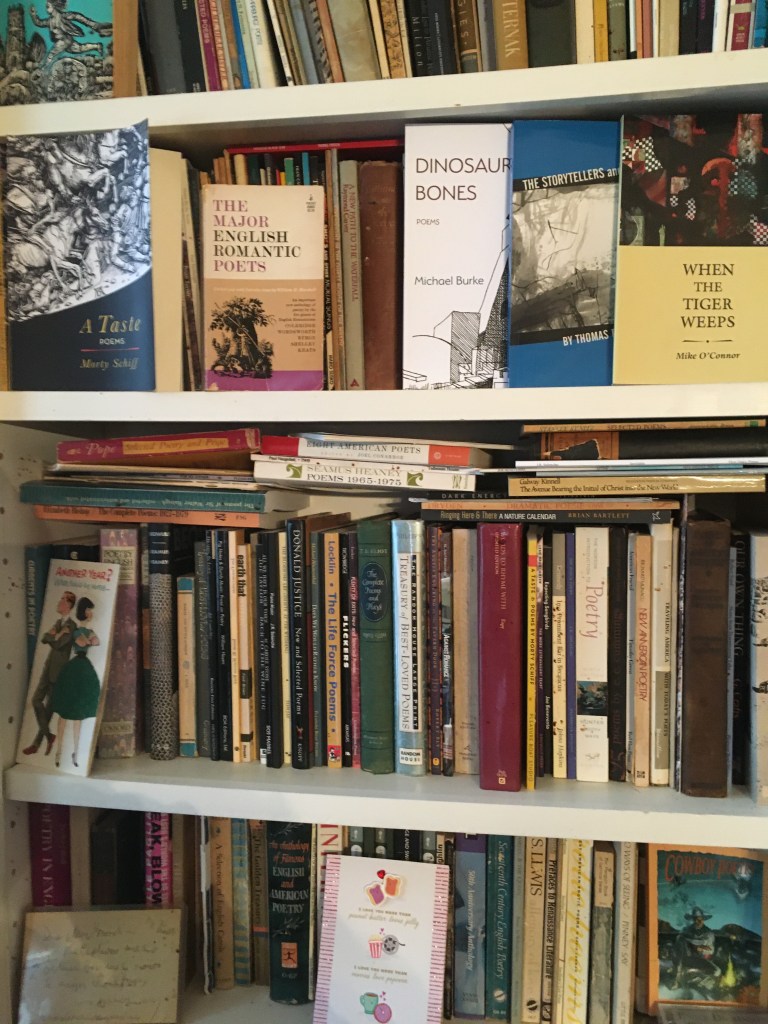
BOOK WRAPT
“Reid Byers, a computer systems architect, coined
a term— ‘book wrapt’ –to describe the exhilarating
comfort of a well-stocked library.”

“The Shelf Life of Home Libraries” in
The New York Times (December 26, 2021)


**
THE INFLUENCE OF BOOKS ON REAL LIFE

“The sculptor Elyn Zimmerman’s iconic rock
and water installation ‘Marabar’ with granite
stones around a pool of water, was named  after
the fictional caves in E. M. Forster’s
novel ‘A Passage to India.’”

“Of Interest” in The New York Times
(Saturday, January 1,2022)
**
SELLING WORDSWORTH TO THE MODERN
READER


&  so I crushed his face
Under my muddy boots,
Sending pieces of his tongue
deep into his throat.
My other hand crept
Under the skirt of his widow.
I pushed her to the bed &
She was not unwilling.
Now that I've got your attention,
I want to tell you
About the friggin' daffodils,
Just how many of them I saw.


Louis Phillips
WEIGHING GOLD DUST
nDURING THE GOLD RUSH IN THE YUKON
(Circa 1898)


“The trick for the weigher was to make some of that
dust stick to his own fingers. Some weighers cultivated
mandarin-length fingernails to collect the golden grains;
others kept their fingers moist and dusted them off in
the leather pockets of their trousers; still others wore
their hair long and well-oiled, frequently running their
fingers through it and ending the night with a vigorous,
lucrative shampoo.”

John Burke. Rogue’s Progress: the Fabulous Adventures
of Wilson Mizner (New York: G.P. Putnam’s Sons, 1975)
**
ELEVATOR OPERATOR

About Mathilda  who ran the elevator in
Philosophy Hall  at Columbia University
for over 20 years:

“I am not too sure she takes too seriously the books
we write, the courses we give, or the courses students
take; but I know that many of us take seriously the serene, unillusioned kindliness and friendliness with which she has learned in her car to survey the world. “I have seen
people go up and up,’ she once remarked; “I continue
to go up and down.” And while doing so, she has found
and communicated wisdom and peace.

 Irwin Edman. Philosopher’s Holiday (New York:
The Viking Press, MCMXXXVIII

**
DOCTOR

"I was born dead. Two doctors, that is to say, announced
my death before they had the honour of announcing my birth;
 the nurse from whom I heard this story was furiously
indignant; she prided herself on never losing a baby.
Meanwhile my young mother was more dead than alive, and
this alarming pair of doctors next proceeded into her
 room, intent upon saving her life. Oddly enough, in
view of so much bungling, they eventually succeeded."

Lady Eleanor Smith. Life's a Circus. New York:
Doubleday, Doran & Company, 1940)

**

POPULAR SONG WRITER IN RUSSIA


“For those who wonder what Russians sing besides the
Volga Boatman and Ochi Chernyia, Vasili Pavlovich
Solovyen-Sedoi, Russia’s top Tin Pan Alley man has
the answer. Sedoi’s simple , easy-to-hum melodies flow constantly out of Russian radios. In restaurants and
cabarets, couples sway nightly to such Sedoi hits as Nightingale, It’s Long Since We’ve Been Home. More
important yet, Songwriter Sedoi manages to please
Russia’s culture cops, who regard dzhaz as ‘vulgar
musical stew.’ This year , Sedoi won his second Stalin
prize.
   The Seeing Eye. Sedoi  scores his biggest hits with
nicely blended combinations of patriotism, sentiment,
wartime allusions and love. Like most U.S. tune-smiths,
he writes only the music, leaves the lyrics to more lyrical minds.”

Time. (July 27, 1947)
**

BEAUTY PAGEANT CONTESTANT

“I wouldn’t normally enter a beauty pageant, but this one is special. It’s a battle for the title of Miss Ex-Yugoslavia, beauty queen of a country that no longer exists. It is due to
The country being ‘no more’ that our shoddy little contest is happening in Australia over eight thousand miles from where Yugoslavia once stood. My fellow competitors and I are immigrants and refugees, coming from different sides of the conflict that split Yugoslavia up. It’s a weird idea for a competition – bringing young women from a war-torn country together to be objectified but in our little diaspora, we’re used to contradictions.”

Sofija Stefanovic. Miss Ex-Yugoslavia. (New York:
Atrria Books, 2018)

**
PIRATE

"Sir Henry Morgan, (born 1635, Llanrhymney, Glamorgan
[now in Cardiff], Wales—died August 25, 1688, probably Lawrencefield, Jamaica), Welsh buccaneer, most famous
of the adventurers who plundered Spain’s Caribbean
colonies during the late 17th century. Operating with
the unofficial support of the English government,
he undermined Spanish authority in the West Indies."

BRITANNICA.  Online edition)

**
Never count the teeth of a comb; if you do, they will all break out.
AMERICAN PROVERB
EDWIN BOOTH ON A STORMY NIGHT IN MARCH 1865

" One stormy night in March 1865, the famous American
actor, stood on the platform of the Jersey City
railroad station. He had just finished a successful
run of Hamlet at the New York Winter Garden, and he
was now on his way to visit his sister in Philadelphia.
   Railroad tickets were then sold on the open platform,
which was dangerously crowded that night as people
milled around the conductor trying to buying sleeping-
car space.
    Suddenly, a young man standing beside Booth was
violently jostled and losing his footing, plunged to
the tracks, falling into the space between two cars.
At that very moment, the cars started to move; the
train was getting underway.
    Horror-stricken,Booth threw himself down on the
platform, leaned far over the stone edge and with
the strength born of desperate urgency, grasped the
terrified young man under the arms and pulled him to
safety.
     Saved from certain death beneath the crushing
wheels of the train, the shaken young man now
overwhelmed the rescuer with thanks. Then, looking
at him closely, he asked Booth if he was not the
famous actor.
      Booth acknowledged that he was, and the man
smiled with pleasure.
       It's a great honor to meet you, sir. And may
I introduce myself. My name is Lincoln -- Robert
Lincoln. I am the son of the President.
       A few minutes later the two men parted,
young Robert profuse in his thanks, and Booth
understandably elated that he had rescued the
President's son.

Doug Storer, Encyclopedia of Amazing but True Facts.
New York: New American Library, 1980)
**
JUNETEETH

"'Juneteenth' marks the 1865 date when a Union officer,
arriving in Galveston, brought news that the slaves
were free. In 1981, Juneteenth was not well known outside
Texas; a search of the New York Times database from 1885 through 1980 doesn't yield a single reference.

Laura Lippman.  My Life as a Villainess (NY: William
Morrow, 2020)
**
A BRIEF HISTORY OF DRIVE-IN MOVIES, or The HOLLINGSHEAD CHRONICLES

Many people hear stories of their grandparents going
to the drive-in theater for a Friday night hangout,
but do you know the history of the classic movie experience?

Though there were drive-ins as early as the 1910s,
the first patented drive-in was opened on June 6,1933
by Richard Hollingshead in New Jersey. He created it
as a solution for people unable to comfortably fit
into smaller movie theater seats after creating a mini
drive-in for his mother. Appealing to families,
Hollingshead advertised his drive-in as a place
where “The whole family is welcome, regardless
of how noisy the children are.”

The success of Hollingshead’s drive-in caused more
and more drive-ins to appear in every state in the
country and spread internationally as well.
Drive-ins gained immense popularity 20 years later
during the 1950s and ‘60s with the Baby Boomer
generation. There were over 4,000 drive-ins
throughout the U.S., and most were in rural
areas. They maintained popularity as both a
space for families to spend time with each
other as well as an affordable date night option.

from THE NEW YORK FILM ACADEMY WEBSITE
**

WILMA RUDOLPH

Wilma Glodean Rudolph (June 23, 1940 –
November 12, 1994)
was an American sprinter, who became a
world-record-holding Olympic champion
and international sports icon in track
and field following her successes in
the 1956 and 1960 Olympic Games. Rudolph
competed in the 200-meter dash and won
a bronze medal in the 4 × 100-meter relay
at the 1956 Summer Olympics at Melbourne,
Australia. She also won three gold medals,
in the 100- and 200-meter individual events
and the 4 x 100-meter relay at the 1960
Summer Olympics in Rome, Italy.[3]
Rudolph was acclaimed the fastest woman
in the world in the 1960s and became
the first American woman to win three
gold medals in a single Olympic Games.

FROM WIKIPEDIA"
**
ABOUT THE ORIGIN OF THE WORD "TYCOON"

In 1853, Commodore Matthew Perry sailed with four
armed ships to Edo, to see about opening up trade
between the UnitedStates and Japan. He negotiated
 with a Shogun, who had been given the title
"taikun," meaning Prince.

The following is from NPR'S CODE SWITCH WEBSITE:

Perry's negotiations were eventually successful.
He and the Japanese would sign the Treaty of Kanagawa
in 1854. The treaty ended Japanese isolation and
guaranteed a "permanent friendship" between the
two nations. Perry would return to the United States
in 1855. Upon his return, Congress voted to grant
Perry a $20,000 reward for his successful work in
Japan. Perry went on to publish an account of
the expedition titled Narrative of the Expedition
of an American Squadron the China Seas and Japan.

As for the word "taikun": It quickly became "tycoon"
in English when Perry brought the word back with him
to the United States, first appearing in print in 1857.
Among the fans of the word were two of President Abraham Lincoln's most trusted aides — John Hay and John Nicolay.
 The pair often referred to Lincoln as "the Tycoon" and references to "the Tycoon" appear frequently in Hay's
diaries.

"The Tycoon is in fine whack," Hay wrote in a letter
in 1863. "I have rarely seen him more serene & busy.
He is managing this war, the draft, foreign relations,
and planning a reconstruction..."


from CODE SWITCH: WORD WATCH
The History Of How A Shogun's Boast Made Lincoln A 'Tycoon'
Code Switch by LAKSHMI GANDHI
October 14, 201310:14 AM ET

**
ABOUT THE N. Y. GIANTS’ MANAGER JOHN McGRAW
“A good part of McGraw’s popularity in New York came from saloon attendance. He truly believed he was an Irish brawler, but won no fights until he discovered the Lambs, a club for actors on West 44th Street. There he found a great truth: tenors can’t fight. In the bar well after closing hours, an actor named William Boyd, while complaining on behalf of the cleaning women aboutMcGraw’s language, hit McGraw over the head with a water pitcher. Down went McGraw. A musical comedy star, John C. Slavit and Winfield Liggitt, a retired naval officer who loved actors, got McGraw home toBroadway at 109th Street at 8 A.M.’
“I was born eight dollars short.” Wilson Mizner
**
WAKING UP IN THE MORNING
THINKING ABOUT BILLY THE KID

Out of the blue it comes to me,
What Pat Garrett sd
About Billy the Kid,
That Billy "Dranked and laughed,
Rode and laughed,
Talked and laughed,
And killed and laughed."
Damn it!
Today's Tuesday,
That's exactly what I want to do.

Louis Phillips
NEWYORK NEWSPAPERS IN THE 1920s
The newspapers, the Journal and American, later
combined , were dedicated to ”noise in the news”
and had an editorial view of the world from
inside a bedroom, or at the rail of a police desk
at night. These tales were printed in newspapers
that practiced bribery, extortion, calumny, also
known as slander, and two kinds of lies., bald-
faced and by omission. Anybody on the staff
who performed an act without malice was
regarded as a dreadful amateur. There was
great confusion in the office, for sometimes
the sins being committed at typewriters were
greater than the ones being written about.
There was no situation so bad that a fresh
edition of the morning American or evening
Journal couldn’t make it worse. Yet the working
conditions were the best in the history of the
business, for nobody died at an early age of
the worse of maladies, seriousness.
Jimmy Breslin. A Life of Damon Runyon (NY:
Ticknor & Fields, 1991)
BRENDA STARR --REPORTER
Dalia Messick had ambitions to create a comic strip from her early days; she submitted her first strip, Weegee, in the mid-1920s, when she was just out of high school.[3] After studying at The Art Institute of Chicago, she got a job designing greeting cards.[4] During the 1930s, Messick submitted three more comic strips—Peg and Pudy and Streamline Babies were about "Depression-era heroines born ahead of their time, working girls come to the big city to earn their living", while Mimi the Mermaid explored a fantasy theme. Feeling that editors were prejudiced against female cartoonists, Dalia signed these strips with a more ambiguous first name, "Dale". Still, these strips were each rejected.[3]

In 1940, Messick created a new heroine—a "girl
bandit" named Brenda Starr—whose looks were modeled
on the film star Rita Hayworth, and named after a
popular debutante, Brenda Frazier.[5] She submitted
the new strip to the Chicago Tribune-New York News
syndicate, but the syndicate chief, Joseph Medill
Patterson, "had tried a woman cartoonist once...
and wanted no more of them." Patterson's assistant,
Mollie Slott—later the vice president of the
syndicate—saw the discarded samples, and encouraged
Messick to make Brenda a reporter. Patterson accepted
the strip, but ran it in the Chicago Tribune's Sunday
comic book supplement, rather than the daily paper.
He refused to run it in his other paper, the New
York Daily News, which finally carried Brenda Starr
in 1948, two years after Patterson's death.[3] After
the strip was established, other instances of resistance
were reported. "Whenever Ms. Messick drew in cleavage
or a navel, the syndicate would erase it. She was
once banned in Boston after showing Brenda smoking
a polka dot cigar."[6]

from Wikipedia
DOROTHY KILGALLEN ON JACK RUBY

"I'd like to know how in a big, smart town
like Dallas, a man like Jack Ruby -owner of
a strip tease honky tonk - can stroll in and
out of police headquarters as if it was a health
club at a time when a small army of law enforcers
is keeping a 'high security guard' on Oswald.
Security! What a word for it."

Mark Shaw. The Reporter Who Knew Too Much.
(Franklin Tennessee: Post Hill Press, 2016)
REED WHITTEMORE AS TELEVISION CRITIC

A television set sits at my left hand a window
at my right -- which shall I look at and out?
The TV,obviously, I am paid munificently by this
noble rag* to watch the tube and its vision of
life, not the yellowing leaves and the blue sky.
Nature's programs change slowly, except for
occasional storms they offer no challenge to
the journalistic mind. And nature's art is
excessively subtle; it knows not the world
bludgeons. No, the journalist must stick with
his tube -- and of course his newspapers."

* The New Republic

Reed Whittemore. The Poet as Journalist
(Washington, D.C.: The New Republic Books,
1976)
ON MEN, WOMEN, & JOURNALISM
“The journalist who spoke at the vocational event was a woman sportswriter for the
Los Angeles Times. She was very charming, and she mentioned in the course of her talk that there were very few women in the newspaper
Business. As I listened to her, I suddenly realized that I desperately wanted to be a journalist and that being a journalist was probably a good way to meet men.”
Nora Ephron. “Journalism: A Love Story” in I Remember Nothing and Other Reflections (NY:’ Alfred A. Knopf, 2010)
**
ABOUT THE 1932 MOVIE—20,000 YEARS IN SING SING ,
STARRING SPENCER TRACY AND BETTE DAVIS
“It was very unusual to see banner headlines from real newspapers l
ike The New York Times and The New York Herald-Tribune. Perhaps
the producers wanted to add a documentary-like realism to the story.
Most movie screaming headlines from that era were from fictitious
newspapers. For example, the favorite paper on the Perry Mason
series was The Los Angeles Chronicle, a paper that did not exist.
IdmB Trivia
*THE MOST FAMOUS NEWSPAPERMAN ON TELEVISION?
Actor Ed Asner, who died in August 2021, was well-known for portraying the newspaperman Lou Grant. Ed Asner, in fact, was the first tv star to win Emmys for playing the same character in both a comedy and drama series. In his obituary, written by Anita Gates (the New York Times, August 30,2021), Ms. Gates noted that ” ‘Lou Grant’ (1977-82) itself was an usual case, a drama series developed around a sitcom character.In the show, Mr. Grant returned to his first love, editing a big-city newspaper, and the scripts tackled serious issues that included in the first season alone, domestic abuse, gang rivalries, neo-Nazi groups, nursing home scandals and cults.” ** ALL RIGHT–MAYBE CLARK KENT WAS THE MOST FAMOUS TV NEWSPAPER REPORTER
Kent, Clark Joseph Award winning journalist and novelist. Clark Kent was born in Smallville, Kansas, where he grew up o n his family’s farm. He played football in high school (Man of Steel miniseries #1), Following his graduation from high school, Kent wandered the world for a while, but finally attended Metropolis
University (World of Metropolis #2). He became [briefly] the protégé of world-famous journalist: Simone D’neige, in Paris.Kent’s first journalism job was with the Daily Planet, where he had the honor of getting the first full length story on Superman. He has a reputation for getting many of the stories about Superman.
KING KONG AND GUSTAVE DORE
“…there were some beautiful moments in King
Kong; that we both appreciated the location given
us for the scene when you held me in your left hand
and pulled at my skirt with your right hand, as though
taking petals from a flower. That’s the way I think of
it because that’s my disposition to make a poetic
metaphor. The background was inspired by the paintings of Gustave Dore, a wondrously quiet, mystical mountain right
on the edge of outer space. You brought a petal of my
skirt to your nose and snuffed it.
from an open letter to King Kong in FAY WRAY.
On The Other Hand: A Life Story (New York:
St. Martin’s Press, 1989)
Fay Wray’s autobiography is dedicated to:
For Susan, Robert, Victoria,
Nora, & Jacob
And for all the young-in-heart
Who have loved
King Kong.
*
BEWARE!CAUSTIC REVIEWER AT WORK
"When the film Smash-Up, starring Susan Hayward and
Lee Bowman, was released in 1947, Life magazine
said he played his part with all the enthusiasm
of a stuffed moose.”
Beverly Linet. Susan Hayward: Portrait of a Survivor (New York: Atheneum, 1980)
**
THE POPULAR POET EDGAR GUEST & ALAN LADDAt Alan Ladd’s crypt in the Sanctuary of Heritage in
Forest Lawn, there us Bronze bust of the movie star.
“On a plaque beneath the bust a poem –‘Success’ –
had been inscribed, its irony only for those who knew:
ALAN LADD
SEPTEMBER 3, 1913 –JANUARY 29,1964
I HOLD NO DREAM OF FORTUNE VAST,
NOR SEEK UNDYING FAME,
I DO NOT ASK WHEN LIFE IS PAST
THAT MANY KNOW MY NAME.
AND I CAN LIVE MY LIFE ON EARTH
CONTENTED TO THE END
IF BUT A FEW SHALL KNOW MY NAME
BUT PROUDLY CALL ME FRIEND.
--Edgar A. Guest
Beverly Linet; Ladd: The Life, The Legend, the Legacy
of Alan Ladd (New York: Arbor House, 1979)
**
TRIVIA ABOUT THE FILM TAKING PLACE IN THE OLD WEST
OF THE 19th CENTURY -- “THE BOY FROM OKLAHOMA”
STARRING WILL ROGERS, JR.
“The sheriff tries to arrest Turlock for allowing
underage drinking, but 21 wasn't established as
the minimum until 1933.”
--IdmB Trivia
**
UNA MERKEL SAVES THE LIFE OF A CREW MEMBER
During the filming of True Confession (1937)
she rescued a movie property man Arthur Camp
from drowning at Lake Arrowhead, California,
when the backwash from her motorboat upset his
skiff. She caught his suspenders with a boat hook
and held him until help arrived from the shore.
Camp was unable to swim.
ImbD Trivia "Una Merkel:"
**
ESSENTIAL FILM VOCABULARY
“Just as Eskimos have twenty words for different
Kinds of snow (denoting how important snow is in their world) filmmakers have almost as many words for different kinds of money.”
Michael Goodwin and Naomi Wise. On the Edge: The
Life & Times of Francis Coppola (New York:
William Morrow and Company, Inc. 1989).
ON TELEPHONE SCENES & FILM ACTING
“The test of any screen actor worth his salt is the
way he handles a telephone scene. Adolph Menjou’s
scene in The Front Page was an example of this,
and of course, Luise Rainer’s in The Great Ziegfeld
won her an Oscar.”
Frank Tuttle
Quoted in Ladd: The Life, the Legend , the Legacy
of Alan Ladd by Beverly Linet (New York: Arbor House, 1979)
**
A RUSSIAN TAKE ON ALFRED HITCHCOCK’S FILM NOTORIOUS
“ One of the many pictures dealing with the secret
of the atom, with the intention of turning away
the attention of the public from the real problems
connected therewith.”
Soviet Art (1947)
**
ON THE MOVIES & THE BIBLE
Stanley Donen,
Reading in the Bible about Onan,
Thought: “Thanks to Joseph Breen,*
I cannot bring that story to the screen.
**
*Hollywood's Censor: Joseph I. Breen and
the Production Code Administration Hardcover –
November 2, 2007
by Thomas Doherty (Author)
ON TELEVISION & MOVIE WESTERNS
Wagon Train—
It does not take Einstein’s brain
To describe the plot:
Settlers are attacked; Indians shot.
**
ON ADAPTING BOOKS FOR THE MOVIES
Lewis, Jerry—
Acquiring film rights to I, The Jury,
Announced: “I shall play Mike Hammer.
Of course, I shall add physical humor!”
3 Clerihews by Louis Phillips
**






 PhillipsMiscellany