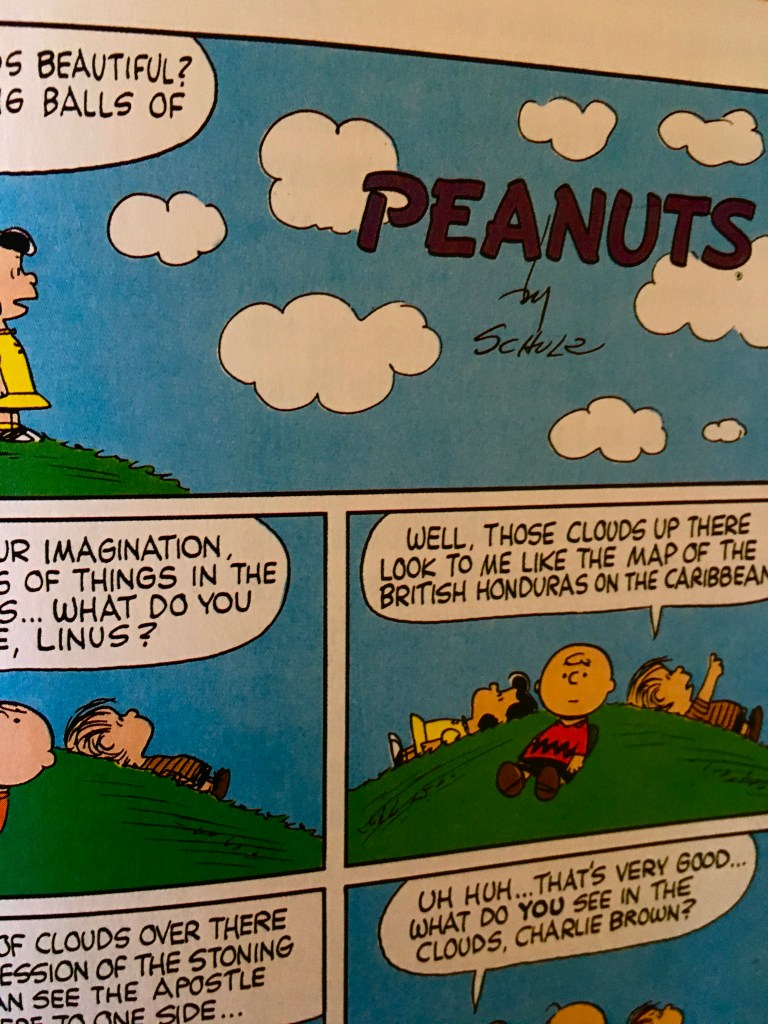
“Peanuts” Was the First Major Comic Strip to Feature a Minority Character

Schulz was intentional about a lot of things when it came to how he framed his famous comic strip, but most especially when it came to race. The majority of the Peanuts gang had always been white, mostly because the cartoonist felt unsure as to whether it was his place to include minority characters in his story lines. But things changed in 1968 following the assassination of Dr. Martin Luther King, Jr. Schulz received a letter from a woman asking him to add an African American character to the comic, and three months later, in July 1968, Franklin made his comic strip debut, picking up and returning a beach ball that Charlie Brown had lost.
Critics have noted that Franklin is more nondescript than his white counterparts, but Schulz’s longtime friend and fellow cartoonist Robb Armstrong once said that he thought Schulz “played it smartly” with Franklin. “He was always very thoughtful in how he treated his characters,” Armstrong told NPR in 2018. And in fact, Schulz actually dedicated Franklin’s last name to Armstrong after the pair developed a friendship that lasted until Schulz’s death in 2000. Armstrong is the creator of JumpStart, one of the most widely syndicated Black comic strips ever."

INTERESTING FACTS (August 11,2024)
**
WORDSMITH on the word GRAWLIKS

(GRAW-liks)

MEANING:
noun: The characters, such as @#%$*!, used to convey profanity in a comic.
ETYMOLOGY:
Coined by the cartoonist Mort Walker (1923-2018). Earliest documented use: 1964.
USAGE:
“This title contains ... negligible cursing (sometimes represented as a grawlix).”

Adult Books 4 Teens; School Library Journal (New York); Mar 2019.
**
I was a religious reader of every comic in both The Daily News and The Daily Mirror throughout high school. So much so that when I went off to the University of Virginia, my mother would cut out the strips every day, put them in order along with the complete Sunday comic sections and mail them to me every Monday for all of my college years. I didn't detoxify from my comic addiction until I began my film career, in Greece of all places.

Nelson Breen, Emmy Award Winning Film-maker

**

THE GIRL WHO INSPIRED LOIS LANE

 An October 29, 1975, article in The Washington Star by John Sherwood claims that Lois Lane was named after Lois Amster, a Cleveland girl whom Joe [Shuster] had a crush on. She was not even aware of his existence. 'She's a grandmother now in Cleveland, ' says Joe, 'but I don't think she has any idea that she was the inspiration for Lois Lane.'

DELANCY PLACE COM. (APRIL 11, 2024).
**

ZASU PITTS & OLIVE OYL

"When the comic strip "Thimble Theatre" became the animated series "Popeye", the producers used Pitts' hand-wringing and nervous speech pattern to characterize the on-screen persona of Olive Oyl."

iMDb TRIVIA

**

E.C. SEGAR'S POPEYE & THE WORD GOON

"Practically everyone read Popeye the Sailor frequently enough to feel almost as though friends of the sailor man were next-door neighbors. That was the case with a lumpy look hulk whom Segar called 'Alice the Goon' -- first drawn in 1919.
       "It took only a few frames of sketches to learn that the Goon was tough as well as rough. Borrowing from the funny paper in the roaring Twenties, its devotees persuaded the world to call any hired thug a goon."

Webb Garrison. Why You Say It (New York: MJM Books, 1992)
**

BRENDA STARR, GIRL BANDIT

"Brenda Starr was originally created as a “girl bandit” character, but creator Dale Messick was encouraged to make the Rita Hayworth-esque Starr a reporter instead so that the Chicago/New York syndicate would pick it up. Not only that, but the creator was using a pen name: Knowing that the publisher had sworn off “women cartoonists,” Dalia Messick switched to the more male-sounding name Dale Messick professionally. But even after it was accepted, Brenda Starr, Reporter still got second-class treatment, at least initially — when it first published in 1940, Brenda was relegated to the Sunday comic book supplement rather than the daily paper. Luckily, Brenda was a star, and the strip was a success long after Messick stopped writing it in 1982.

From INTERESTING FACTS website  (September 29,2022)


OF COMICS & THE BIBLE

“In 1941 , he (Max Gaines)  produced Picture Stories from
the Bible, a fifty-cent, 232-page collection that as a contemporary put it, ‘strictly in the comic-book technique, yet with sensationalism left out.” Although the title first met a rocky reception, religious leaders, including Norman Vincent Peale, eventually endorsed it. Eight hundred thousand copies of the book were sold in two years, and it was read in over two thousand Sunday schools. Gaines may not have been as saintly as the figures his book portrayed (“I don’t care how long it took Moses to cross the desert, “I want it in three panels.”

Jeremy Dauber. American Comics : A History (New
York: W.W. Norton & Company, 2022)
**

TARZAN HELPS DEFEAT THE NAZIS

The Ape-Man has also been involved in international political chaos that includes fighting in World War I….
   “ The Ape-Man battled the Axis in another time, as Tarzan in another media – motion pictures. In the 1943 film Tarzan Triumphs, Nazis invade the jungle and Johnny Weissmuller’s Tarzan, after uttering that immortal line, ‘ Now, Tarzan make war!’ goes out and thrashes them.”

from Tarzan, Jungle King of Popular Culture by David Lemmo | 2016
**

SATIRISTS IN AFRICA

"...all over Africa, where satirists are often the boldest commentators on politics and vice. 'Cartoonists use visual imagery as a kind of mask, to conceal in order to reveal,' says Ganiyu Jimoh, a Nigerian cartoonist and scholar. He compares the wit and allusions in cartoons to the traditional masquerades in Yoruba culture, in which masked performers would ridicule the powerful. As an adage has it, 'Oba kii mu onkorin': the king does not arrest a satirist."

Political Cartoons in Africa: the king does not arrest a satirist." in The Economist (June 17th-23rd 2023)

**


**

VILLAIN WITHOUT EYEBROWS

"In All-Star Superman, it's revealed that Luthor has no eyebrows, likely a side effect of his baldness. He draws them on, which leads to a scene at the end of his spotlight issue where, after accidentally wiping off his left eyebrow, he draws it back on, but does so incorrectly due to lacking a mirror. This results in him giving Clark Kent an evil lecture about how he'll be remembered forever as the man who killed Superman, while he has a comically misshapen eyebrow that looks as if he's doing a Dreamworks Face."

https://tvtropes.org/pmwiki/pmwiki.php/Main/NoBrows
**
 T. CAMPBELL, Editor of Word Play and a Comic Book researcher told his blog followers on Sept. 9, 2024:

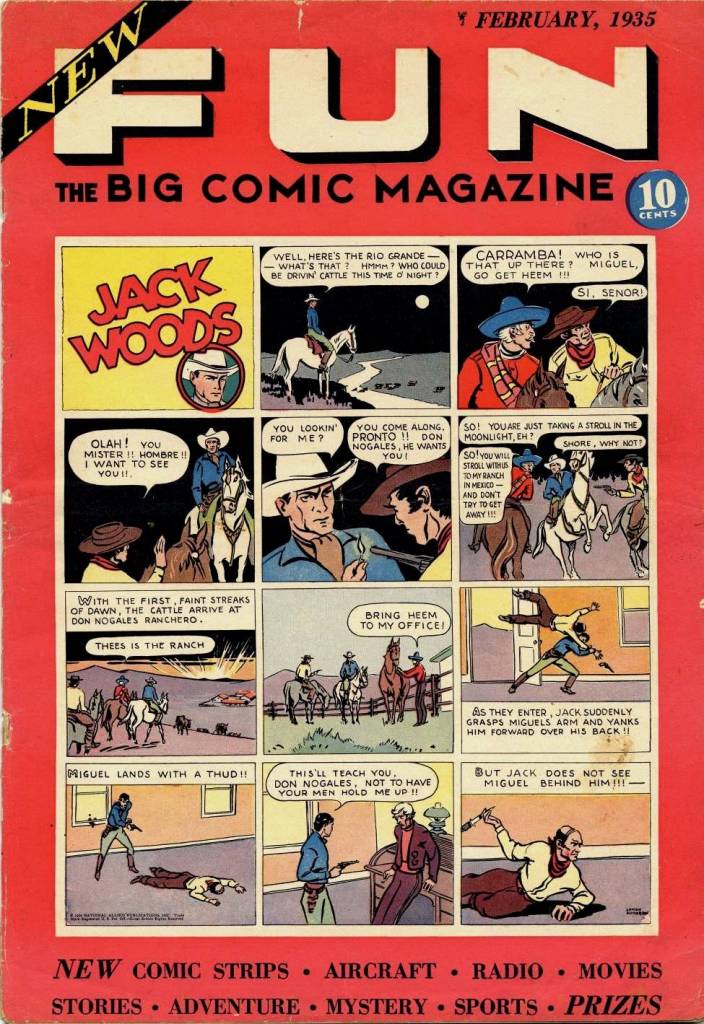
Last time, I mentioned New Fun #1 (1935) as a claimant to the title of “first comic book.” That means the first comic-book hero might be Jack Woods. Woods was a Texas Ranger surrounded by the kind of Mexican caricatures who shot “Carramba” (sic) and “Get heem!” His first comics adventure began even before page one of the comic—kicking off on the cover itself!
**
HOW ORPHAN ANNIE’S DOG GREETED
THE COMPOSER OF CARMINA BURANA
Arf,
Orff.
**
DAGWOOD & BLONDIE
The comic strip Dagwood & Blondie ––
I read it on Sunday, Monday,
Tues, Wednesday, Thurs, Fri, & Sat.
That’s that
TARZAN
King of the Jungle, Tarzan
Lived without cars and
TV, so he considered it just fine
To spend days swinging on a vine.
ROBERT RIPLEY
Robert Ripley
I followed him triply:
In newspapers, on radio, & TV. I thought
His oddities were wonderful: BELIEVE IT OR NOT.
Louis Phillips
 PhillipsMiscellany
Who else but Lou would enlighten us to the origins of the word goon?
LikeLike