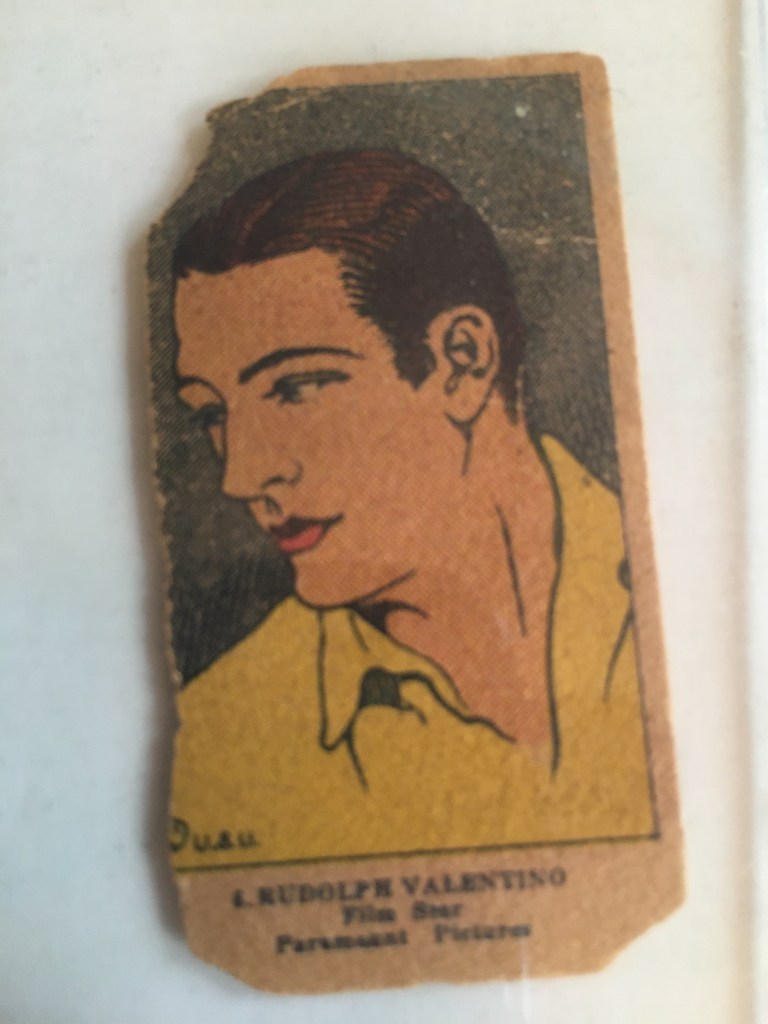
from The "The Latin Lover" and His Enemies by Gilbert King
Smithsonian Magazine (June 13,2012)

Born in Castellaneta, Italy, in 1895, Valentino arrived
at Ellis Island in 1913, at the age of 18. He lived on
the streets and in Central Park until he picked up work
as a taxi dancer at Maxim’s Restaurant-Caberet, becoming
a “tango pirate” and spending time on the dance floor
with wealthy women who were willing to pay for the
company of exotic young men.

Valentino quickly befriended a Chilean heiress, which
might have seemed like a good idea, but she was unhappily married to a well-connected businessman named John
de Saulles. When Blanca de Saulles divorced her husband
in 1915, Valentino testified that he had evidence that
John de Saulles had been having multiple affairs,
including one with a dance partner of Valentino’s.
But his refined, European and youthful appearance
at the trial had some reporters questioning his
masculinity in print, and John de Saulles used his
clout to have the young dancer jailed for a few days
on a trumped-up vice charge. Not long after the trial,
Blanca de Saulles shot her husband to death over
custody of their son, and Valentino, unwilling to
stick around for another round of testimony and
unfavorable press, fled for the West Coast, shedding
the name Rodolpho Guglielmi forever.

***
WATCHING MOVIES (Circa 1915) IN SOME SMALL
FARM TOWNS IN THE UNITED STATES

Sometimes we would go to the Airdrome,which
was nothing but some benches facing a big
white screen inside a galvanized iron enclosure
and, at the back, a motion-picture machine that
an operator turned with a hand crank. In the
wintertime, there were movies in the D.A.R.
Hall, but it was too hot there in the summer
months. The heat in the hall wouldn't have
been as bad the mosquitoes in the Airdrome,
but we were too thrilled by The Perils of
Pauline, The Trey of Hearts and The Girl and
the Game to notice the bugs. I even enjoyed
the lantern-slide advertisements.

Emmett Kelly. Clown (New York: Prentice Hall,
1954)

 MOVIE SLANG=-Circa 1940s


Footlight Serenade, My Gal Sal, Coney Island, Diamond
Horsehoe, Where Do We Go From Here? among others.
They symbolized a whole decade: beautiful women,
healthy men, clean love and just enough sex to
Make it look real (a ‘touch of the muff’ they
called it.

Phil Silvers. This Laugh Is On Me, with Robert
Saffron (Englewood, N.J. Prentice Hall, 1973.
THE PRISON SET FOR THE FILM “COOL HAND LUKE”
While passing by the prison camp set, a San Joaquin County
building inspector thought it was a recently constructed migrant
workers’ complex, and posted “condemned” notices on the buildings
for not being up to code.
from Trivia about COOL HAND LUKE (ImdB)
BUSTER KEATON WRITES ABOUT HIS FACE

Down through the years my face has been called
a sour puss, a dead pan, a frozen face, The
Great Stone Face, and, believe it or not, 'a
tragic mask.' On the other hand that kindly
critic, the late James Agee, described my face
as ranking 'almost with Lincoln's as an early
American archetype, it was haunting, handsome,
almost beautiful.' I can't imagine what the
great rail splitter's reaction would have been
to this, though I sure was pleased.

Buster Keaton,with Charles Samuels. My Wonderful
World of Slapstick (Garden City, New York:
Doubleday & Company, 1960)
**
ON THE PERILS OF OVEREATING

“Marco Ferreri’s “La Grande Bouffe” is to gastronomy as “The Exorcist” is to “Song of Bernadette,” which is to say eat before you go, you won’t be hungry afterward.
                                        ROGER EBERT
**
  ON THE CREATION OF SAX ROHMER'S DR.FU MANCHU

   "The Boxer Rebellion at the turn of the century
had aroused fears of a 'Yellow Peril," and Rohmer
recognized  that popular literature was ready for
an Oriental archcriminal. His research for an
article on Limehouse had divulged the existence of
a 'Mr King,' an actual figure if immense power in
the Chinese district of London. His enormous
wealth derived from gambling, drug smuggling, and
the organization of many other criminal activities.
... One foggy night, Rohmer saw him-- or someone
who might have been him -- from a distance: his
face was the embodiment of Satan. This was Fu
Manchu, the Devil Doctor.

Chris Steinbrunner and Otto Penzler. Encyclopedia
of Mystery and Detection (New York: McGraw Hill,
1976)

GARY COOPER IS ASKED IF HE KNOWS YIP
HARBURG, THE MAN WHO COMPOSED THE
 SONGS
FOR THE WIZARD OF OZ


Yip?

Yep.


Louis Phillips
 PhillipsMiscellany
The Emmett Kelly remembrance of watching films in “farm country” reminded me of a cold night in a small mountain village on Crete in December 1966: it seemed the entire village turned out to watch “The World of Henry Orient” projected on a sheet hung outside the one church, young and old shivering under blankets, utterly entranced by the adventures of 2 private high school girls chasing after Peter Sellers. It was a great lesson in the power and magic of cinema. (A few years later, I would date Tippy Walker who played one of the girls.)
LikeLike
Thank you, Louis.
LikeLike
Terrific, as usual.
LikeLike
Loved all these, but of course the Gary Cooper is priceless!
LikeLiked by 1 person
THANK YOU!! HOPE YOU REMAIN HEALTHY.
LikeLike
Gip?
Yep.
Sip?
Yep.
LikeLike
Good stuff, Louis (again)!
LikeLike