On READING

jjhON READING

I like to read on the beach. Once I took a “Neuromancer” paperback to Bora Bora
 and it was so humid there that every time
I turned a page it came unglued and fell
away from the book. I was slowly leafleting
the island with William Gibson, although
I like to think you could read single pages
and still get the gist. As the last page fell
away from the spine I was holding what
looked like a gluey fish skeleton.

Laurie Anderson, in “By the Book”
(The New York Times Book Review,
February 2020)
 **


THE DECLINE AND FALL
OF THE ROMAN EMPIRE
ACCORDING TO THE DICK
& JANE READER


See S.P.Q.T. run.

 **
First time around, my eyes were opened
to something important about who I  was
at the moment of reading; later, to who or
what I was becoming. But then I lived
long enough to feel a stranger to myself –
no one more surprised than me that I
turned out to be who I am.”

Vivian Gornick, on reading Natalia Ginzburg.
“Look Again” by Alexandra Schwartz
(The New Yorker, February 10, 2020)

‘**
 In the nineteenth century, when its literature
equaled that written at any place at any one
time in history, Russia had no 'great' woman
writer--no Sappho, no Ono, no Komachi or
Murasaki Shikibu, no Madame de Stael or
George Sand, no Jane Austen or George
Eliot--or so we might say when surveying
the best-known works of the age. But we
now know this truth to be less than true.
  Karolina Pavlova, born Karolina Karlovna
Jaenisch in Yaroslavi in 1807, died in
Dresden in 1893, after having lived outside
Russia for four decades....

Barbara Heldt. "Karolina Pavlova: The Woman
Poet and the Double Life" -- Introduction to
A Double Life by Karolina Pavlova, translated
by Barbara Heldt (New York: Columbia
University Press, 2019).

**

ON MICHAEL CONNOLLY & THE HARDY BOYS
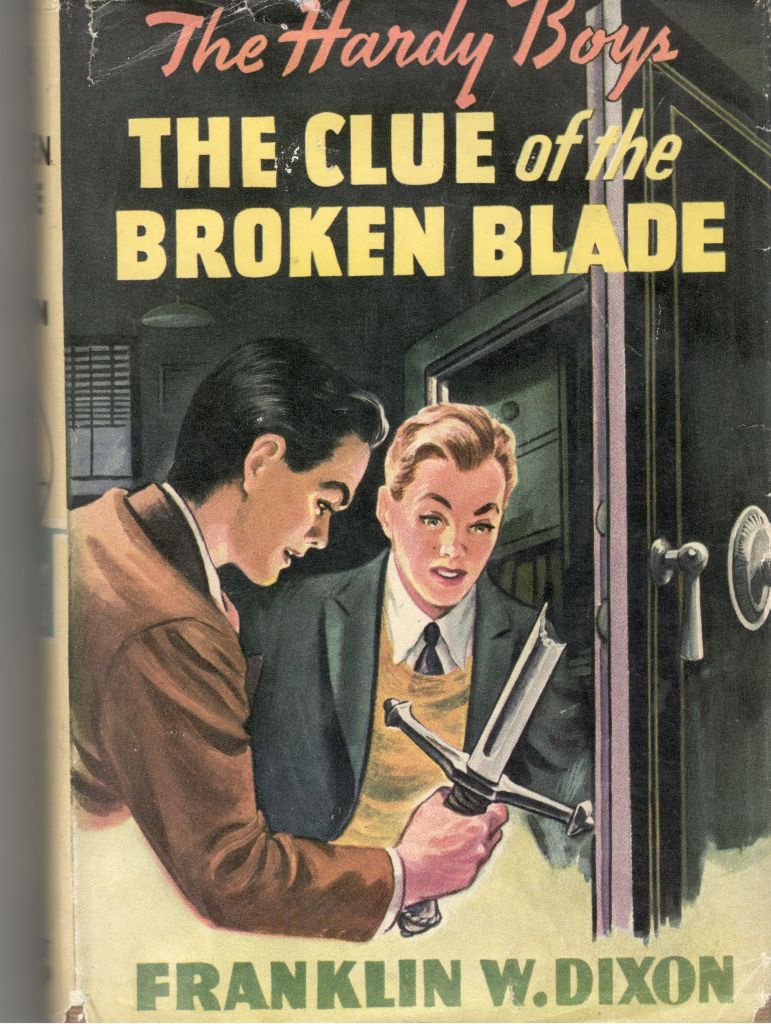
  In  Number 3 of  The Hardy Boys Series
-- THE SECRET OF THE OLD MILL – as the
story gets underway, there is a plug for the
previous two adventures:

      "However, the Hardy boys had inherited
much of their father’s ability and deductive
talent. Already they had aided in solving
two mysteries that had kept Bayport by
the ears. As related, in “The Hardy Boys:
The Tower Treasure,” they had solved
the mystery of the theft of valuable jewels
and bonds from Tower Mansion… In
the second volume of the series, “The Hardy
Boys: The House on the Cliff,” has been
told how the Hardy Boys discovered the
haunt of a gang of smugglers…"

Now, if that isn’t an example of post-modernism
in literature,  I do not know what is.  It is also
smart marketing. Any reader starting the
series at any point beyond the first volume
would soon be hustled back to buy the
books he missed.  I have to admit that
age 11,I had no idea what bonds were,
but at least I knew they were valuable.


GOING BEYOND THE BOUNDS OF FICTION IN MICHAEL CONNELLY’S  THE CROSSING

If   the creators of THE HARDY BOYS SERIES
were clever and postmodern in promoting
books in their series, Michael Connelly goes
them one better in crisscrossing the
boundaries of fiction and reality. In
Chapter 12 of Connelly’s Hieronymus
Bosch novel The Crossing, Connelly’s
other famous character The Lincoln Lawyer
(Mickey Haller)  steps outside the novel
to become a living person who has had
a film made about him:

  ‘Haller missed the entire session with Foster.
He was either a celebrity lawyer or a notorious
lawyer, depending on how you looked at it.
He had received the ultimate imprimatur
of L.A.  acceptance – a movie about one
of his cases starring no less than Matthew McConaughey.”

   The more I think about the above paragraph,
the more confused I get about the blurred
boundaries of fact (the movie) and fiction (the character who has a movie made
about his adventures). Obviously a ton
of fictional characters have been brought
to life on the screen, but the movies never
became part of those characters’
identity/biography in the books they appeared.

**

                                ON WRITING

    I think  it is the fault of all American books,
including my own. They pant so after meaning.
They are earnestly moral, didactic; they build
 them ever more stately mansions, and they
exhort and plead and refine, and they are,
insofar, books of error. A work of art should
not rest on perception. “Here,” in other
words, “is my vision, be meaning what it may.”

Saul Bellow in a letter
to Ruth Miller (July 27, 1955)

**

  I write for self-entertainment, and perhaps
to afford the world after I have left it, some
notion of what strange beings may pass
through it without its knowledge.

         George Darley
 **


I am not a scientist and don’t deal in formulas,
but as a writer I would, in the words of
Henry James, take to myself “the faintest
hints of life” and convert “the very pulses
of the air into revelations.”
                           E.L. Doctorow
                   The Nation (July 14, 2008)


I was recently asked what it takes to become
a writer. Three things, I answered: first, one
must cultivate incompetence at almost
every other form of profitable work. This
be accompanied, second, by a haughty
contempt for all the forms of work that
someone has established one cannot do.
To these must be joined, third, the nuttiness
to believe that other people can be made
to care about your opinions and views and
be charmed by the way you state them.
Incompetence, contempt, lunacy--once
you have these in place, you are set to go.

 JOSEPH EPSTEIN

Commentary (April 2004)
**


     “Ernest Hemingway once said that an
author must know the entire iceberg to
write about only the tip. This has become
a basic tenet among suspense novelists:
Learn everything about an important topic
but include just the fraction of details
relevant to the story.”

Lisa Gardner. “A Visit to the Body Farm” in
The New York Times Book Review
(July 28,2019)


The consideration governing the presentation
of popular information may be reduced to
three fundamental laws:  The Law of Irrelevant
Details, which maintains that the writer can
interest any reader in the commonplaces
of everyday occurrences by adding even more commonplace details about them; Mencken’s
Law of the  Boobeosie by which the writer
 assumes that the reader knows virtually
nothing; and the Law of Conservation of Space,
by which the writer is compelled to pack
a sentence like airline  luggage, with
no superfluous articles.

Dr. Leo Hamalian. “The Case of the Missing
Articles” in American Mercury  (March. 1957).


THE FUTURE OF WRITING & READING NOVELS


"Laura Esquivel physically incorporates music
in her novel The Law of Law,which includes
a CD. Indicators on pages refer to specific
tracks, signalizing the points to pause and listen.
This not only better appreciate the arias
recorded in the book but also engages the
audience in a way that wouldn't be possible
without music."

Kevin Moises Suarez. "Author's Playlist" in World Literature Today (Winter 2020)
 PhillipsMiscellany
Always enjoyable to read your blog.
LikeLike